February 17, 2026
Biological Age vs Chronological Age: What's the Difference?
Your chronological age is fixed. Your biological age is not. This article explores the science behind biological aging, how it’s measured through epigenetic clocks and biomarkers, and why it predicts disease risk and longevity more accurately than the number on your birth certificate. Most importantly, it shows how lifestyle, stress, diet, and environment can either accelerate or slow your body’s true aging process
Discover Your Real Age
You know your birthday.
You know how many candles go on the cake.
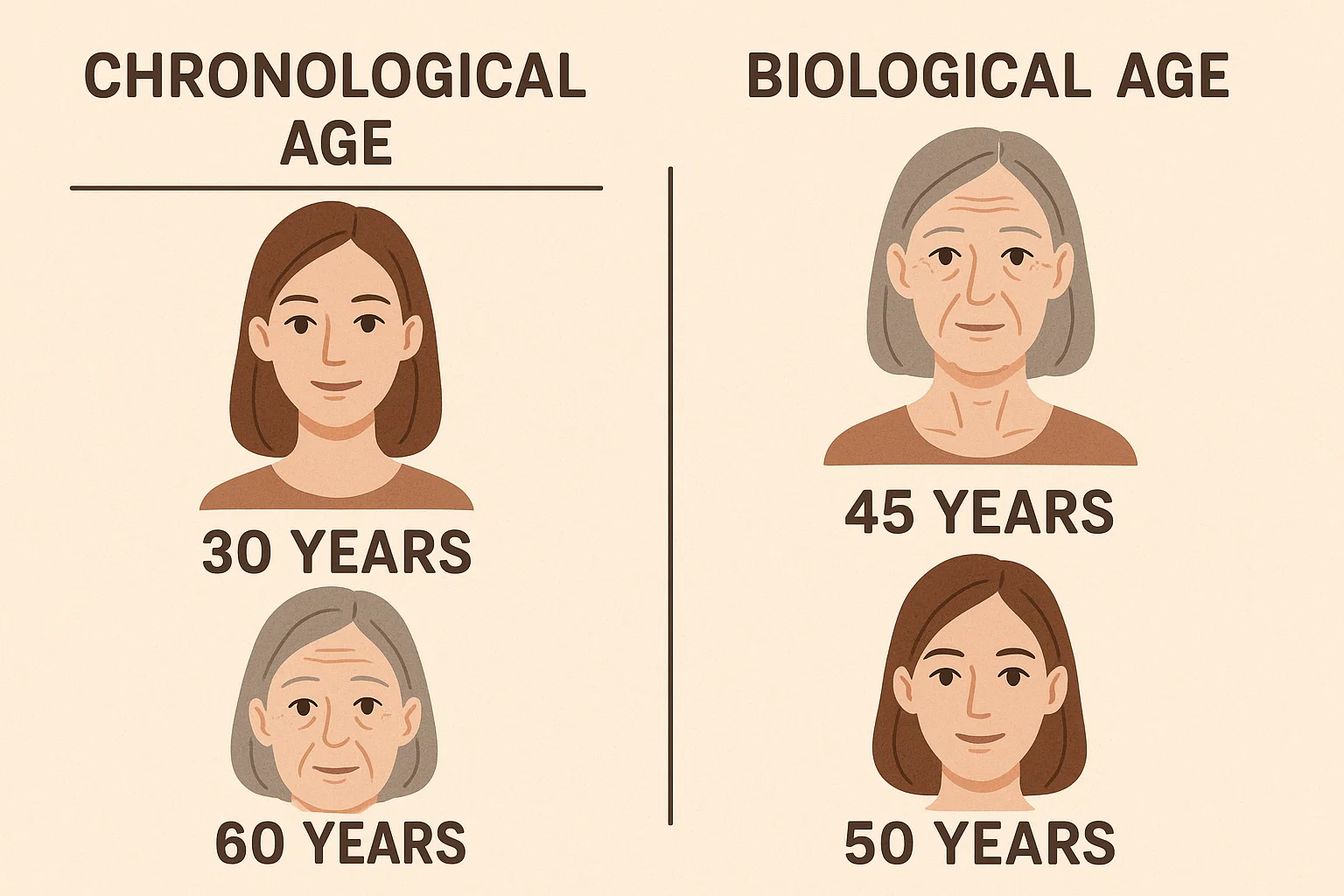
But that number, your chronological age, tells only part of the story of how your body is actually aging. Two people who share the same birth year can look, feel, and function decades apart from each other. That gap has a name: the difference between biological and chronological age.
Understanding this distinction is no longer just academic. It is becoming one of the most important frameworks in modern medicine for predicting disease risk, guiding prevention strategies, and measuring the real-world impact of lifestyle choices on longevity.
What Is Chronological Age?
Chronological age is the simplest possible measurement: the total amount of time that has passed since your birth. It increases at a fixed, identical rate for every person on earth, regardless of genetics, health, or lifestyle.
For most of recorded history, chronological age has been used as the primary proxy for biological functioning. It determines when you can drive, vote, retire, and access healthcare benefits. It is what your doctor enters at the top of your medical chart.
The problem is that chronological age is a blunt instrument. It tells you how long someone has been alive, but nothing about how well their cells, organs, and systems are holding up. A 50-year-old marathon runner and a sedentary 50-year-old with metabolic syndrome share the same chronological age. Their bodies tell a very different story.
What Is Biological Age?
Biological age, also referred to as physiological or functional age, is a measure of how old your body actually acts based on its physical condition and cellular health. Unlike chronological age, it is not fixed. It can be higher or lower than your calendar age depending on a range of factors: genetics, lifestyle, nutrition, stress levels, sleep quality, environmental exposures, and the presence or absence of disease.
According to Mayo Clinic, the distinction matters because biological age is a far more accurate predictor of health outcomes, disease risk, and mortality than the year printed on your birth certificate. Individuals with a biological age significantly younger than their chronological age tend to have better organ function, lower inflammatory markers, and a reduced risk of age-related conditions.
The gap can be substantial. Research consistently shows that individuals of the same chronological age can differ by 10 to 20 years in biological age measures, and those differences have real consequences for health and longevity.
Why the Gap Between Biological and Chronological Age Matters
The implications of this distinction reach well beyond academic biology.
A Harvard Bioethics analysis notes that because chronological age is currently used as the primary legal and medical proxy for functional ability, people whose biological age differs significantly from their calendar age face real consequences for healthcare access, insurance, employment, and social policy. As epigenetic clock technology matures, the case for biological age to play a larger role in these contexts grows stronger.
From a health prediction standpoint, the stakes are concrete. Research cited in the Harvard Bioethics analysis found that for every 5 years a woman's biological age exceeds her chronological age, her breast cancer risk increases by 15%. Other studies show that biological age outperforms chronological age in predicting the onset of depression, cardiovascular events, and cognitive decline.
A 2025 Frontiers in Neurology meta-analysis confirmed that accelerated biological aging as measured by DNA methylation clocks is an independent predictor of stroke risk, operating above and beyond traditional vascular risk factors. A biological age younger than your chronological age is associated with slower functional decline, better physiological resilience, and reduced all-cause mortality. The reverse signals accelerated wear across multiple systems simultaneously.
Biological Age and the Future of Preventive Medicine
The growing ability to measure biological age accurately is shifting medicine from a reactive model toward genuine prevention. Rather than waiting for disease to develop, clinicians can use biological age gaps as early warning signals that a person is aging faster than expected and intervene before organ damage becomes irreversible.
The Frontiers in Aging Longevity Med Summit research describes a paradigm shift in how aging is understood, with twelve identified hallmarks now including telomere attrition, epigenetic alterations, chronic inflammation, and mitochondrial dysfunction forming the basis of targeted anti-aging interventions. Measuring which hallmarks are most active in an individual can guide genuinely personalized strategies.
A Closer Look: Methods, Accelerators, and Protectors
How Biological Age Is Measured
Several validated methods capture biological age, each measuring a different layer of cellular and physiological aging. Research published in 2025 describes the field as having advanced rapidly, with epigenetic tools now estimating biological age across diverse tissues with remarkable precision.
A key insight from research on Nature Aging is that DNA methylation-based estimators accurately capture biological aging rather than elapsed time, as they correlate with mortality risk and shift in response to interventions.
What Accelerates vs. Slows Biological Aging
Biological age is not destiny. A PMC review on modifiable lifestyle factors found consistent evidence that diet quality, physical activity, smoking, and alcohol consumption all influence epigenetic clocks and telomere length. The direction and scale of the effect depends on the behavior, its duration, and whether multiple factors compound.
Frequently Asked Questions
- What is the main difference between biological age and chronological age?
Chronological age counts years since birth and is identical for everyone born on the same day. Biological age reflects the actual functional state of your cells and organs, shaped by genetics, lifestyle, and environment, and can be significantly higher or lower than your calendar age.
- How is biological age measured?
The most validated methods are epigenetic clocks based on DNA methylation patterns (GrimAge, PhenoAge), telomere length analysis, and composite clinical biomarker panels. Each captures a distinct dimension of cellular aging, and together they provide a more comprehensive picture than any single test.
- Can you actually reduce your biological age?
Yes, research supports it. Consistent lifestyle interventions, including regular exercise, anti-inflammatory eating, quality sleep, and stress management, can measurably slow epigenetic aging and protect telomere length, with some studies documenting statistically significant reductions in biological age scores.
- What lifestyle factors most accelerate biological aging?
Smoking has the largest documented single-factor effect on epigenetic clock advancement. Chronic stress, high-inflammatory diets, physical inactivity, and poor sleep all compound. Environmental exposures, such as air pollution, further accelerate the rate of change independent of behaviour.
- Why does biological age predict health outcomes better than chronological age?
Because it captures individual variation that chronological age completely misses. Studies consistently show biological age outperforms calendar age in predicting cardiovascular events, cancer risk, cognitive decline, depression, and all-cause mortality.
Curious how your own biological age compares?
At-home biological age tests, including epigenetic clock kits and telomere length panels, are now widely available. Knowing your baseline is the first step toward targeting the lifestyle factors that matter most for your specific aging trajectory.
That’s why at Chairon House, understanding your biological age is central to our approach to wellness coaching. Our AI-powered platform helps you identify the lifestyle factors most relevant to your aging trajectory and build sustainable habits that work with your biology rather than against it.
Whether your goals are to reduce your biological age, protect cognitive function, or simply feel better day to day, our evidence-based coaching adapts to your data and keeps your focus on what actually improves outcomes.
Age Is Not Just a Number — It’s a Signal
Chronological age marks time. Biological age measures impact. When you understand the gap between the two, you gain something powerful: control. By targeting inflammation, stress, metabolic health, and lifestyle behaviors, you can influence how your body ages at a cellular level. The future of preventive medicine isn’t about waiting for disease. It’s about measuring early, acting intelligently, and aging on your own terms.
Build a Longevity Strategy That Works With Your Biology
Knowing your biological age is only the first step. Our AI-powered wellness coaching translates your biomarkers into actionable strategies — from nutrition and sleep optimization to stress regulation and metabolic resilience — designed to slow biological aging and improve measurable outcomes over time.