March 27, 2026
GLP-1 Diet Guide in Dubai: What to Eat (and Avoid)
Struggling with Ozempic or Mounjaro side effects? Learn exactly what to eat (and what to avoid) to stop the nausea and maximize fat loss in Dubai.
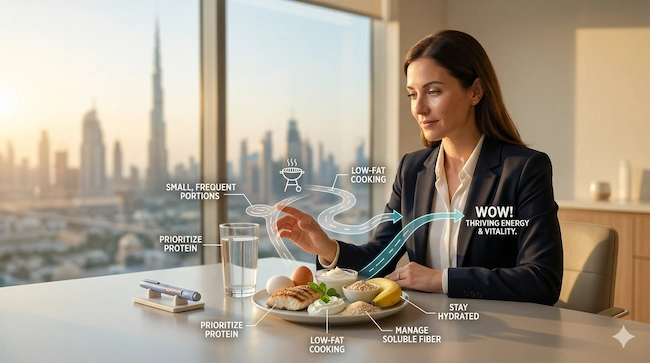
Stop guessing why you feel unwell.
You are ready to transform your body. You have the prescription, you have started the injections, and you are watching the scale.
But then, it hits you.
The crippling nausea. The brick in your stomach is bloating. The soul-crushing fatigue that makes your 9 AM meeting in DIFC feel like a marathon.
Recently, a 38-year-old executive walked into our clinic. She had lost 4kg in six weeks, which sounds like a win. But she was miserable. She was ready to throw her medication in the bin because she felt so unwell.
Her bloodwork? Perfectly fine. The medication? Doing exactly what it was designed to do.
The culprit was actually on her plate.
It’s a mistake we see every single day in Dubai. Most people focus so much on the “drug” that they forget the fuel. When you are on a GLP-1 protocol, the old rules of eating do not just change; they are completely rewritten.
If you do not adapt your diet to your new biology, the side effects become the only thing you remember about your weight loss journey.
The good news? It is an easy fix once you understand the science.
This guide is your roadmap to thriving on GLP-1s. We are going to show you exactly how to eat so you can keep the fat loss, ditch the nausea, and finally start feeling like the high-performer you are.
Wow! Let's get your energy back.
What Are GLP-1 Medications and Why Does Diet Matter So Much?
GLP-1 receptor agonists (glucagon-like peptide-1 receptor agonists) are a class of medications that mimic a gut hormone your body naturally produces after eating. They slow gastric emptying, which means food moves more slowly from your stomach into your small intestine, and they suppress appetite by signalling satiety to the brain.
This is precisely why they work so well for weight management and blood sugar regulation. But it also explains why dietary habits become critical. When gastric emptying is deliberately slowed, eating the wrong foods containing too much fat, too much fibre at once, or too much volume creates a bottleneck that your digestive system cannot easily process.
For UAE residents in particular, there are additional factors at play. The local food culture leans heavily on rich, high-fat dishes and large portions at social gatherings. Ramadan eating patterns, long fasting windows followed by calorie-dense Iftar meals, can severely amplify GLP-1 side effects if not managed carefully. Our clinical team adjusts protocols specifically around these patterns.
The Science: How GLP-1s Affect Your Digestive System
To understand why food choices matter so much, it helps to understand what these medications are doing at a physiological level.
GLP-1 agonists bind to receptors throughout your gastrointestinal tract, pancreas, and brain. In the gut, they slow the rate at which the stomach contracts and empties its contents, a process called gastric motility (the rhythmic muscular movement that pushes food through your digestive system). In the pancreas, they stimulate insulin release in response to glucose and suppress glucagon (the hormone that raises blood sugar between meals). In the brain, they act on the hypothalamus to reduce appetite and increase feelings of fullness.
The result is a triple mechanism: you eat less, you absorb glucose more slowly, and your insulin response becomes more efficient [Source: Drucker DJ, New England Journal of Medicine, 2016].
The digestive side effects, like nausea, bloating, and constipation, are direct consequences of this slowed motility. When food sits in the stomach for longer than usual, it creates pressure, fermentation of certain foods (particularly high-FODMAP carbohydrates), and delayed signal transmission to the lower gut, which often results in constipation [Source: Nauck MA et al., Diabetes Care, 2021].
A separate mechanism also contributes to nausea: GLP-1 receptors in the area postrema (a region of the brainstem that regulates nausea and vomiting) are directly activated by these medications, particularly at higher doses or during dose escalation phases.
The good news: understanding this mechanism makes the dietary interventions intuitive, not arbitrary.
What to Eat on GLP-1s: The Core Principles
Prioritise Protein at Every Meal
Protein is your most important macronutrient on a GLP-1 protocol, and most patients are not eating enough of it.
When appetite is suppressed, the risk is that overall calorie intake drops so sharply that the body begins metabolising muscle tissue for fuel. This is sometimes called sarcopenic weight loss, losing muscle rather than fat — and it undermines both the health outcomes and the aesthetics of the treatment. Clinical evidence suggests that adequate dietary protein (a minimum of 1.2–1.6g per kilogram of body weight per day) significantly reduces muscle loss during calorie-restricted periods [Source: Churchward-Venne TA et al., American Journal of Clinical Nutrition, 2012].
Practical choices in a UAE context: grilled hammour, chicken breast, labneh, eggs, Greek yoghurt, and lean cuts of lamb. These digest more efficiently than high-fat protein sources and are widely available here.
Most patients at our clinic notice that smaller, protein-forward meals are far better tolerated than traditional three-course meals, even when reduced in portion size.
Eat Small, Frequent Portions
Because gastric emptying is slowed, large meals create disproportionate discomfort. A meal that would feel normal off medication can feel unbearable on it.
The adaptation is simple but requires discipline: eat every 3–4 hours in small portions rather than two or three large meals. Think of each eating occasion as a "snack-sized meal" rather than a formal meal. A fist-sized portion of protein, a small amount of complex carbohydrate, and a tablespoon of healthy fat is a workable template.
This is particularly relevant for patients fasting during Ramadan. We advise breaking the fast very gently, dates and water first, a small bowl of soup, then a modest protein portion — rather than the typical Iftar spread.
Choose Low-Fat Cooking Methods
Fat is the slowest macronutrient to digest under normal conditions. On GLP-1 therapy, high-fat meals compound the already-slowed gastric emptying and are a leading trigger for nausea and upper abdominal discomfort.
This does not mean avoiding fat entirely. Healthy fats, olive oil, avocado, and small amounts of nuts, are still important for hormonal health and fat-soluble vitamin absorption. The issue is volume and cooking method: deep-fried foods, rich cream sauces, and fatty cuts of meat are disproportionately problematic.
Switch to grilling, steaming, baking, and poaching. A simple change from a traditional machboos preparation to grilled protein with saffron-spiced rice, for example, can make a significant difference to digestive comfort.
Stay Meticulously Hydrated
Constipation is consistently ranked as one of the most disruptive side effects of GLP-1 therapy, and dehydration is a major contributing factor — particularly in Dubai, where the climate accelerates fluid loss year-round.
The target is a minimum of 2.5–3 litres of still water daily, more in summer months or on training days. Warm or room-temperature water is generally better tolerated than ice-cold water, which can trigger gastric cramping in some patients.
Avoid carbonated beverages entirely during the first 8 weeks of treatment. The gas volume in sparkling water and sodas interacts badly with a stomach that is already processing food more slowly.
Incorporate Gentle, Soluble Fibre
Fibre is nuanced on GLP-1s. Insoluble fibre (found in raw vegetables, bran, and whole grains) can accelerate constipation symptoms paradoxically when motility is already sluggish, it adds bulk that has nowhere to move. Soluble fibre (found in oats, sweet potato, ripe banana, and psyllium husk) forms a gel in the gut that softens stool and supports bowel regularity without creating additional pressure.
Start with small amounts and increase gradually. A tablespoon of psyllium husk stirred into water each morning is a simple, effective intervention that many of our patients find genuinely helpful after the first two weeks.
Who Is This Guidance For?
You will benefit most from a structured GLP-1 nutritional plan if you are:
- Currently on semaglutide (Ozempic, Wegovy), tirzepatide (Mounjaro), or liraglutide (Saxenda)
- Experiencing nausea, bloating, constipation, or reflux, and are unsure whether to continue your medication.
- About to start a GLP-1 protocol and want to optimise your experience from day one
- An expat or frequent traveller in Dubai whose dining habits involve a lot of restaurant meals, business lunches, or social eating
- A busy professional who tends to skip meals or eat large portions infrequently
We particularly see this picture in Dubai's HNW and executive population: highly functional individuals who are managing demanding schedules and have not had the bandwidth to redesign their eating habits around the medication.
Who Should Not Self-Manage GLP-1 Nutritional Changes Without Medical Supervision
If any of the following apply to you, please discuss your nutritional plan with a physician rather than self-directing:
- History of an eating disorder: calorie restriction combined with appetite suppression requires careful, supervised management
- Type 1 diabetes: the interaction between GLP-1 therapy and insulin requirements is complex and must be medically monitored
- Active gastroparesis: further slowing of gastric motility can be dangerous
- Severe gastro-oesophageal reflux disease (GORD): GLP-1s can worsen reflux in some patients with pre-existing conditions
- Pregnancy or breastfeeding: GLP-1 medications are contraindicated in pregnancy; dietary changes should be supervised regardless
- History of pancreatitis: GLP-1 medications have a small associated risk, and nutritional intake must be managed carefully
- Recent bariatric surgery: the interaction between surgical and pharmacological changes to gastric function requires medical oversight
Always consult a DHA-licensed physician before making significant changes to your eating plan during any pharmacological protocol.
What to Expect: A Practical Timeline
Weeks 1–4 (Dose Initiation)
This is typically the most challenging window. Nausea is most common during dose initiation and escalation phases. Keep meals extremely small, think egg-sized portions of protein, crackers, and broth-based soups. Do not force yourself to eat if you feel genuinely nauseous; light snacking on something easily digestible (plain rice, banana, low-fat yoghurt) is fine.
Hydration is the most important priority during this window.
Weeks 4–8 (Stabilisation)
Most patients report a meaningful reduction in nausea as the body adapts to the medication. This is the phase to begin reintroducing a broader range of foods like lean proteins, cooked vegetables, and moderate-GI carbohydrates. Constipation often becomes the dominant complaint; this is where psyllium husk, adequate hydration, and gentle movement become critical.
Beyond Week 8 (Maintenance)
With consistent habits established, most patients can eat a nutritionally complete, varied diet without significant digestive disruption. The key is maintaining portion discipline and avoiding the trigger foods identified in your personal experience during earlier phases.
Risks & Side Effects: What We Observe Clinically
Being transparent about side effects is important to us. GLP-1 therapy is well-evidenced and generally well-tolerated, but it is not symptom-free, especially in the early weeks.
Commonly observed side effects related to diet and digestion:
- Nausea: affects approximately 20–30% of patients during dose escalation; usually resolves within 4–8 weeks [Source: Wilding JPH et al., NEJM, 2021]
- Constipation: particularly common in Dubai's climate, where dehydration compounds the effect; managed primarily through hydration and soluble fibre
- Bloating and abdominal discomfort: often triggered by specific food choices (fatty foods, high-FODMAP foods); highly manageable with dietary adjustment
- Gastro-oesophageal reflux: can be worsened if eating too close to lying down; we advise patients not to recline for at least 2 hours post-meal
- Fatigue: often related to insufficient calorie and protein intake rather than the medication itself; a structured eating plan is the primary mitigation
Contact our clinic if you experience:
- Persistent vomiting that prevents adequate hydration for more than 24 hours
- Severe abdominal pain radiating to the back (possible pancreatitis requires immediate medical assessment)
- Blood in stool
- Rapid, unintended weight loss beyond your target protocol
Cost Context in the UAE
Nutritional coaching and dietary planning in Dubai range broadly depending on the setting and level of clinical involvement:
- Single dietitian consultation (standalone): AED 400–800
- Integrated GLP-1 clinical programme (includes dietary plan, monitoring): AED 2,500–6,000 per quarter
- GLP-1 medication costs (varies by drug and dose): AED 800–2,800 per month
At Chairon House, nutritional guidance is integrated into our GLP-1 protocols rather than billed separately. Individual cost is determined by your medication, dose, and protocol length — a personalised quote is provided after your initial consultation.
GLP-1 Therapy in the UAE: Regulations and Safety
GLP-1 receptor agonists are regulated medications in the UAE. They must be prescribed by a licensed physician and, for injectable formulations, administered or supervised within a DHA-approved clinical framework.
What you should verify before starting a GLP-1 programme in Dubai:
- The prescribing physician holds a valid DHA licence (verifiable via the Dubai Health Authority's online licence checker at dha.gov.ae)
- The clinic is licensed to prescribe and administer the specific medication you are using
- You receive a formal consultation, not just a prescription request fulfilled online
- Your protocol includes monitoring, weight, metabolic markers, and side effect assessment at regular intervals
Chairon House operates under a current DHA clinical licence. All GLP-1 protocols are prescribed and supervised by our medical team, and our nutritional guidance is developed in line with MOHAP dietary guidelines for metabolic health management.
Frequently Asked Questions
What is the single most important dietary change to make when starting GLP-1s?
Reducing meal size is the most impactful single change. Because GLP-1 medications slow gastric emptying, eating the same volumes you consumed before the medication creates significant discomfort, such as nausea, bloating, and reflux. Switching to smaller, more frequent meals, ideally every 3–4 hours, allows your digestive system to process food without becoming overwhelmed. Most patients who do this consistently report that nausea becomes far more manageable within the first two to three weeks.
Can I eat normally at social events and restaurant meals in Dubai?
With some planning, yes. The key adaptations are: ordering smaller portions or sharing dishes, prioritising protein and avoiding rich, high-fat starters and sauces, and eating slowly. Dubai's restaurant culture tends toward generous portions and rich preparation; communicating with the kitchen about lighter preparation is generally well-received. During the first four to six weeks, it is worth being conservative at social events; nausea at a business dinner is both uncomfortable and avoidable.
Why am I constipated on GLP-1s even though I'm eating fibre?
The type of fibre matters significantly. Insoluble fibre (raw vegetables, wheat bran) can worsen constipation when gastric motility is slowed, because it adds bulk that cannot move efficiently. Switching to soluble fibre like oats, psyllium husk, ripe fruit, and cooked rather than raw vegetables is typically more effective. Hydration is equally important; a minimum of 2.5 litres of still water daily is recommended in Dubai's climate.
Is it safe to fast during Ramadan while on GLP-1 medication?
This depends on your medication, dose, and individual metabolic status; it is a question for your prescribing physician, not a generalised answer. What we observe clinically is that Ramadan can amplify both nausea and constipation if Iftar meals are large, rich, and eaten rapidly. Patients who discuss their protocol adjustment in advance of Ramadan, including potential dose timing or temporary reduction, generally have a much more comfortable experience than those who do not.
How much protein should I be eating daily on GLP-1s?
Current clinical guidance suggests a minimum of 1.2–1.6 grams of protein per kilogram of body weight per day to preserve muscle mass during calorie-restricted periods. For a 75kg adult, that is approximately 90–120g of protein per day, which requires deliberate planning when appetite is suppressed. Spreading protein across four to five small eating occasions is more practical than trying to hit targets in two or three larger meals.
When should I contact a clinic about my digestive side effects?
Contact your medical team if you are unable to keep liquids down for more than 24 hours, if you experience severe abdominal pain (particularly if it radiates to your back), if you notice blood in your stool, or if you are losing weight at a rate that feels alarming rather than gradual. Mild nausea, occasional bloating, and some constipation in the early weeks are expected and manageable. Persistent, severe, or worsening symptoms are not, and they should be assessed clinically rather than managed through diet alone.
Conclusion
GLP-1 therapy can be genuinely transformative, but the experience of patients who thrive on it versus those who abandon it within the first month almost always comes down to nutritional preparation and support. The medication does not operate in isolation from what you eat.
The core framework is straightforward: small, frequent, protein-forward meals; low-fat cooking methods; soluble rather than insoluble fibre; meticulous hydration; and a clear understanding of your personal trigger foods. Applied consistently, these changes convert what can be a difficult early period into a manageable and eventually comfortable protocol.
Our clinical team at Chairon House works with GLP-1 patients on the full picture of medication, nutrition, movement, and metabolic monitoring rather than prescriptions in isolation.
Conclusion
Like any medical protocol, GLP-1 therapy works best when it is supported by expert nutritional coaching and regular clinical monitoring. Stop fighting your digestive system and start working with it.
Ready to master your GLP-1 journey?
Do not let preventable side effects stop your progress. Schedule a free, zero-pressure chat at Chairon House today. Let us map out a safe, doctor-approved eating plan so you can hit your goal weight without the constant struggle.