April 21, 2026
NAD+ IV Therapy In Dubai: The Complete Guide (2026)
Here’s all you need to know about NAD+ IV therapy in Dubai: mechanisms, protocols, who benefits from it, what to expect, and how to get it at DHA-licensed clinics.
Book Noww
If you notice that your body’s recovery takes longer than it should, or your focus comes and goes at a whim, and the level of sharpness that you’d expect from yourself isn’t always consistently there. You might be quick to judge and attribute this to a discipline or lifestyle problem, but it isn’t. In many cases, it’s actually a cellular energy problem.
NAD+, which stands for “nicotinamide adenine dinucleotide”, is a coenzyme that your cells require to produce energy, repair DNA, regulate inflammation, and sustain a body’s complex neurological function. Unfortunately, NAD+ doesn’t remain as a constant, but rather, NAD+ levels decline gradually as you begin to age.
After your early-20s, the NAD+ levels in your body begin a slow, continuous decline. By the time you reach your 40s, intracellular NAD+ levels may have dropped by as much as 50%. Additionally, high-stress environments further accelerate that decline, including an excess of alcohol consumption, poor sleep, intense training load, and chronic low-grade inflammation, all of which consume NAD+ faster than your body can replenish it.
Thankfully, there is now a clinically-proven solution to solve this. Intravenous (IV) NAD+ therapy works by bypassing the normal absorption ceiling of typical, over-the-counter oral supplementation and delivering the NAD+ coenzyme directly into circulation, where your cells can uptake it immediately.
In a DHA-licensed clinical setting, it’s one of the most evidence-supported interventions currently available for cellular energy restoration, cognitive performance, and metabolic functions. If you’re curious about NAD+ IV therapy, our guide will cover everything you need to know, including the science behind it, the protocols available, who benefits the most, what to expect from a typical session, and how to access it safely in Dubai.
What Is NAD+?
Expanding a bit more on what we briefly explained earlier, NAD+ is a molecule that can be found in every living cell. It primarily exists in 2 forms: NAD+ (oxidised) and NADH (reduced). Usually, your body cycles between them continuously as cells generate ATP (or “adenosine triphosphate”), which is your body’s primary energy currency.
Beyond its purpose as an energy metabolism, NAD+ also serves two other highly critical functions:
1. Sirtuin Activation
Sirtuins are an entire family of proteins that work to regulate gene expression, cellular repair, and metabolic efficiency. As such, they’re often referred to as longevity proteins, and they are completely dependent on NAD+ molecules to function.
Otherwise, without adequate NAD+ levels, sirtuins cannot perform DNA repair, and they cannot regulate inflammatory signalling or be able to maintain mitochondrial health that underlies cellular longevity.
2. PARP Activation
PARPs, also known as “Poly ADP-ribose polymerases”, are your body’s primary DNA repair enzymes. Every strand break, and therefore, every oxidative insult to the genome, subsequently triggers PARP activity to fix it.
Nonetheless, every PARP reaction consumes NAD+. In high-stress environments, PARP activity can deplete intracellular NAD+ substantially, thus leaving it with fewer resources for energy production and everything else that depends on it.
This, then, is the core problem: NAD+ is simultaneously required for energy, repair, and longevity regulation. When NAD+ levels are in short supply, all three will suffer.
Why An IV Delivery, And Not Oral Supplements?
NMN (or “nicotinamide mononucleotide”) and NR (or “nicotinamide riboside”) are both NAD+ precursors, which also exist as oral supplements, and they have attracted fairly significant research interest in recent memory.
Nevertheless, while NMN and NR are properly clinically-proven, legitimate, and effective interventions, they both operate under two meaningful constraints that intravenous (IV) delivery does not share, and thus, are not the same:
- Absorption Ceiling - Oral precursors like these must first be absorbed through your gastrointestinal tract before being converted into NAD+ intracellularly through enzymatic pathways, and then, finally, it’s distributed systemically. As a result, the entire conversion process is very rate-limited, and there is a ceiling to how much NAD+ a given oral supplementation dose can produce in any given time window.
- Bioavailability Variability - Gastrointestinal (GI) health, gut microbiome composition, and individual enzyme activity all have a heavy influence on how efficiently precursors are converted. In other words, even if two different people are taking practically identical doses of NMN and/or NR oral supplements, each person might see substantially different outcomes because of these variables.
Remember what we mentioned earlier, intravenous (IV) NAD+ delivers the coenzyme directly into the bloodstream, and consequently, cellular uptake begins immediately. Unlike NMN and/or NR oral supplementation, there is no conversion bottleneck and no absorption variability.
For context, the clinical effect of a singular NAD+ IV therapy session is typically equal in potency and effectiveness to weeks of consistent oral NMN and/or NR supplementation, which is precisely why an IV delivery is the preferred route for therapeutic applications rather than general maintenance.
Of course, for patients who have already completed a NAD+ IV loading protocol, either NMN and/or NR oral supplementation can easily serve as a rather effective maintenance strategy between sessions. In other words, the two approaches (IV therapy and oral supplements) can become complementary to each other, not just mutually exclusive.
The Science: How Does NAD+ IV Therapy Work?
To better understand what NAD+ and NAD+ IV therapy even are, the mechanisms that underpin them are worth understanding in a bit more detail, as they can explain why the clinical applications of NAD+ IV therapy span such a wide range of different conditions.
So, let’s take a closer look at how NAD+ actually works, and what sort of mission-critical functions it provides to your body:
1. Mitochondrial Function
NAD+ is the essential substrate for the electron transport chain, which is the process by which your mitochondria convert nutrients into ATP. Therefore, when NAD+ levels are depleted, your mitochondrial efficiency subsequently falls along with it.
Cells now produce less energy as a result, generate more oxidative byproducts, and age faster, too. To solve this, restoring NAD+ levels has been shown in multiple independent studies to improve mitochondrial respiration and reduce the markers of oxidative stress.
2. Neurological Function
The brain is the by far most metabolically demanding organ anywhere in your body. With that in mind, those all-important neurons are particularly vulnerable to a depletion of NAD+ levels.
Emerging research has linked declining NAD+ levels to neuroinflammation, impaired synaptic plasticity, and reduced cognitive performance. Furthermore, NAD+ also helps to support the production of neurotransmitters that are involved in mood regulation, which includes serotonin.
3. Inflammation Regulation
On that note, NAD+ also modulates the activity of NF-κB, which is a master regulator of inflammatory signalling. Chronically low NAD+ levels within your body are associated with elevated systemic inflammation, which is a driver of virtually every chronic disease out there, not to mention accelerated biological ageing.
4. Circadian Rhythm
SIRT1, which is a NAD+-dependent sirtuin, directly regulates the core circadian clock genes that govern your sleep-wake cycles and hormonal rhythms. In fact, this is actually the mechanistic basis for the effect of NAD+ levels on trying to recover from jet lag and also making sure that your sleep quality is up to par.
Who Benefits Most From NAD+ IV Therapy?
It should be clear by now that NAD+ IV therapy is not a single-use intervention, but instead, it’s something that you have to commit to regularly to see any positive upsides.
The very same mechanism, cellular energy restoration, can also produce meaningfully varied outcomes depending on a particular patient’s primary concern.
As such, to gauge whether or not a NAD+ IV therapy could be helpful to you, here are some of the most clinically-relevant applications and scenarios, given the typical patient profile that we commonly see here in Dubai:
1. Energy, Fatigue, And Burnout Recovery
Undoubtedly, the most common presentation that we would see at a performance clinic in Dubai is, in fact, not illness, but it’s actually sustained high levels of performance over an extended period of time, without adequate cellular recovery.
This could include burnout among fast-moving corporate executives, overreaching your training, and cumulative sleep debt, all of which share a common downstream effect, which is depleting your body’s already limited levels of NAD+.
In this instance, patients typically report a tangible improvement in their baseline energy reserves within 24 to 72 hours of their first NAD+ IV therapy session. The mechanism of how this works is quite direct: improved mitochondrial efficiency translates to higher ATP output at the cellular level.
[Internal link: NAD+ IV Therapy for Energy & Fatigue in Dubai — full protocol and patient profiles]
2. Cognitive Performance And Brain Fog
Metal clarity is a highly valued competitive advantage in a cosmopolitan city like Dubai. Therefore, for patients who are experiencing the after-effects of brain fog, including a much reduced processing speed, poor working memory, and/or difficulty sustaining an adequate level of focus, NAD+ addresses the neurological substrate directly instead of bypassing it to just focus on the symptoms.
By solving the underlying issue, NAD+ IV therapy does this by supporting mitochondrial functions in your neurons, and by reducing neuroinflammation via surtuin activation. As a result, NAD+ IV therapy has been associated with improving cognitive performance in both healthy adults and patients with neurological complaints.
[Internal link: NAD+ IV Therapy for Brain Fog & Cognitive Performance in Dubai]
3. Jet Lag And Travel Recovery
Dubai is a global transit hub, and as such, unsurprisingly, many of the patients that we get here at Chairon House are crossing 6 or more time zones multiple times every single month. This much travel does put a lot of strain on your body.
Conventional jet lag management, such as light exposure, melatonin, and strategic sleep timing, does work to some extent when it comes to addressing the circadian disruption at the behavioural level. Nevertheless, NAD+ IV therapy addresses it much more thoroughly, at the molecular level.
SIRT1, which regulates your core circadian clock, requires NAD+ to function. Not enough NAD+, and jet lag recovery is gradually slowed. To solve this, a NAD+ IV therapy session that is timed within 24 hours of a major transatlantic or transpacific flight can help to substantially shorten your recovery window.
[Internal link: NAD+ IV Therapy for Jet Lag Dubai: The Traveller's Reset]
4. Metabolic Health And Weight Management
NAD+ plays an important role in fat metabolism through SIRT1 and SIRT3, which regulate adipogenesis, insulin sensitivity, and mitochondrial biogenesis in metabolically active tissue. As you can imagine, depleted NAD+ levels can negatively affect this.
That said, in patients who are undergoing GLP-1 protocols or active body recomposition programmes, NAD+ IV therapy can effectively support the metabolic environment that allows those interventions to work more efficiently and potently.
To be clear, this doesn’t mean that NAD+ IV therapy makes a good standalone weight loss treatment. Rather, it’s a good optimiser that enhances the cellular conditions that are required for effective metabolic improvement.
[Internal link: NAD+ for Metabolic Health & Weight Management UAE]
5. Muscle Recovery And Athletic Performance
High-intensity training, which might include the likes of the Lagree Megaformer, HYROX, or triathlon preparation, creates substantial amounts of oxidative stress loads, while also driving PARP-mediated NAD+ consumption in your muscle tissue.
As a consequence of that, accelerated NAD+ depletion is one of the key reasons why elite athletes hit unexpected recovery ceilings that cannot be resolved so easily through good nutrition and rest alone.
As a solution, a post-event or post-training NAD+ IV therapy session helps to support mitochondrial recovery in your muscles, reduces inflammatory signalling, and shortens the gap to full readiness for your next training block.
[Internal link: NAD+ for Muscle Recovery After Dubai Fitness Challenges]
6. Anti-Ageing And Skin Health
Biological ageing, particularly at the cellular level, is a factor caused by declining NAD+ levels. In addition, telomere shortening, reduced DNA repair capacity, and accumulating senescent cells are all downstream consequences of NAD+ depletion.
Sirtuins, the longevity proteins, are completely non-functional without it. Thankfully, you aren’t without a solution. Regular NAD+ IV therapy is among the most mechanistically grounded anti-ageing interventions currently available today.
On top of that, the effects on your skin, which can include improved dermal resilience, reduced pigmentation irregularity, and enhanced barrier function, are a very visible manifestation of systemic cellular health improvement, all thanks to a timely NAD+ IV therapy.
[Internal link: NAD+ Therapy for Skin Health & Anti-Aging in Dubai]
7. Post-Ramadan Cellular Reset
The typical physiological profile for most people at the end of Ramadan is sadly quite consistent and predictable: altered sleep schedules, shifted circadian timing, and an excess of GI stress from the daily fasting and repeated refeeding cycles, in addition to accumulated sleep debt.
Plus, for those who were also forced to reduce their regular exercise and training load during Ramadan, there is an additional component here that you’d have to consider: deconditioning-related fatigue.
The good news here is that a targeted NAD+ protocol in the 2 weeks following Eid ought to provide a good amount of cellular-level support for the recovery that your body has been attempting to make anyway. In other words, a timely NAD+ IV therapy session can help you accelerate your return to baseline performance and maximum readiness.
[Internal link: Post-Ramadan NAD+ Reset: Cellular Rejuvenation in UAE]
What To Expect From A NAD+ IV Session At Chairon House?
If you’re interested in performing a NAD+ IV therapy session here, at Chairon House, this is what you can expect to happen, from start to finish:
Before Your Session
During this time, a DHA-licensed and trained physician will review your complete health history, current medication list, and assess your personal clinical goals. No doubt more importantly, however, this initial consultation with one of our physicians is also when you’ll be informed of the side effects, risks, and any contraindications that might affect you.
NAD+ IV therapy, while boasting plenty of clinically proven benefits, is contraindicated in active malignancy, and it requires very careful consideration in some patients with certain cardiovascular or neurological conditions. As such, this consultation is not just a formality, but crucially, it also determines your starting dose and infusion rate.
During Your Session
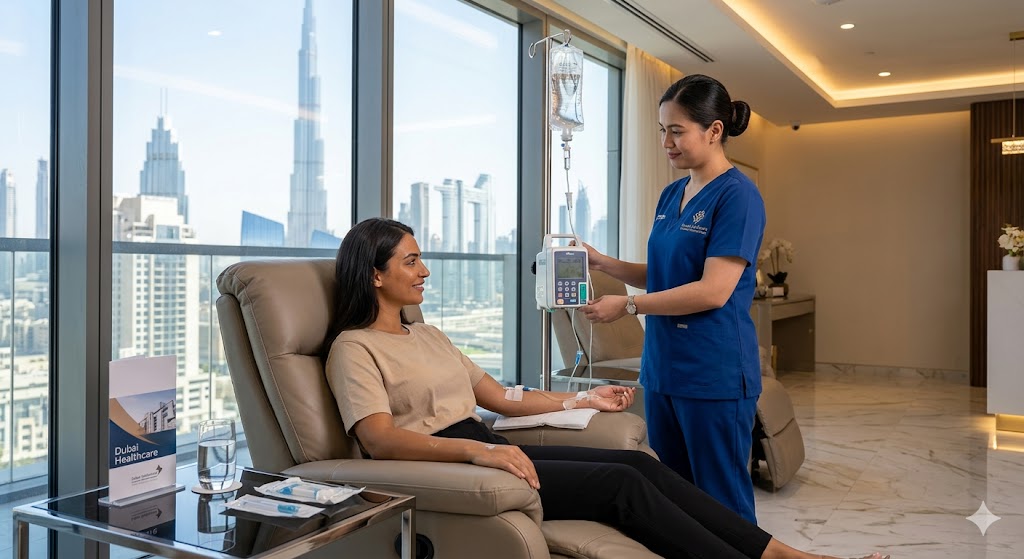
When you begin your session, NAD+ is first administered through an intravenous (IV) drip over a span of 1.5 to 3 hours, depending on the precise dose that was prescribed by the physician and our clinical team during your initial consultation.
The exact infusion rate matters, too. If it’s too fast, patients would commonly experience chest tightness, flushing, nausea, and/or a transient sense of pressure. Now, while these specific sensations are not actually dangerous in this context, they can nevertheless be uncomfortable, unpleasant, and entirely avoidable with proper titration.
Thankfully, our nursing and clinical staff can adjust the infusion rate based on real-time patient feedback throughout the session. Otherwise, common sensations that you may feel during the infusion process would include a mild warmth, a sense of calm alertness, and, particularly in higher doses, a perceptible shift in mental clarity that begins before the drip is even complete.
After Your Session
Once your session is complete, most of our patients often report a sense of improved energy and clarity within the first 24 hours post-session. Some patients might even notice the effects immediately.
Nonetheless, a small number of patients feel briefly fatigued in the first few hours that follow the NAD IV+ therapy session, as their bodies begin to respond to restored NAD+ levels. If you’re concerned about this, don’t worry, because these side effects typically resolve themselves by the following morning.
Protocols And Dosing
There is no universal NAD+ protocol, as the proper clinical dosing is always individualised and personalised for every single patient. However, there are certain frameworks which act as a guide, and the following are some good, common starting points to figure out the appropriate dosing for a specific patient:
- Loading Protocol - For those patients who are new to NAD+ IV therapy, a series of 4 to 6 sessions over a span of 2 to 3 weeks will be quite effective in building one’s intracellular levels more efficiently than sporadic single sessions. Here, the loading doses normally range from 500 mg to 1,000 mg for each session, which will vary depending on the patient’s weight, health status, and tolerance.
- Maintenance Protocol - Following a loading series, most patients would transition to a single session every 4 to 8 weeks. However, patients with a higher NAD+ demand, be it due to heavy training load, frequent long-haul travel, or ongoing high-stress periods, will typically maintain at the shorter interval. The proper dosage would then be adjusted accordingly.
- Targeted Protocols - These are single, one-time sessions for specific purposes, such as trying to improve your jet lag recovery before or after long-haul travel, intense athletic recovery after a sports event, or a post-Ramadan reset. When timed appropriately, they can be clinically effective, but these NAD+ IV therapy sessions usually include mid-range doses that are administered as a one-off or are otherwise paired with complementary infusions.
- Combination Protocols - NAD+ IV therapy is frequently combined and paired with a few other clinical interventions here at Chairon House, where appropriate. These would include peptide therapy (BPC-157 or Sermorelin, for instance), glutathione push for hepatic support, and vitamin C for adjunctive antioxidant coverage, among others.
How often should I do maintenance sessions?
Most of our patients typically maintain at one maintenance session every 4 to 8 weeks following their initial loading series. Nevertheless, some circumstances do warrant a shorter interval, such as higher training loads, frequent long-haul travel, and periods of elevated stress, all of which will negatively affect your NAD+ levels.
Safety Profile, Side Effects, And Contraindications
Although many clinics, medical experts, and academics alike champion NAD+ IV therapy as an effective, clinically proven form of treatment, taking it is not without its risks. On the bright side, unlike most other, more experimental or emerging treatments, NAD+ has a very well-established safety profile when administered correctly by a qualified clinical staff.
To be clear, NAD+ is not a drug, but in actuality, it’s a molecule that your body produces naturally and uses constantly. In this context, it’s only that a therapeutic application will introduce higher concentrations than what would have been achievable through natural endogenous production or through oral supplementation.
So, with that in mind, here are some of the side effects, risks, and contraindications that you could expect, starting with the more common side effects, which are dependent on the infusion rate and are otherwise quite manageable by most patients:
- Flushing and/or warmth
- Transient chest tightness and/or heaviness
- Mild nausea
- Mild headache
- A feeling of internal pressure (it should pass as the infusion rate is adjusted)
- A feeling of agitation (it should pass as the infusion rate is adjusted)
Meanwhile, here are some absolute contraindications that you have to be extremely careful of, and it’s important to speak to your physician about these:
- Active malignancy (NAD+ fuels cellular metabolism indiscriminately)
- Active infection and/or a fever
In addition, here are some relative contraindications that still require a detailed review by a physician before you begin any NAD+ IV therapy session:
- Pregnancy
- A history of seizure disorder
- Certain cardiovascular conditions
- Current usage of PARP inhibitor medications (with oncological contexts)
Once again, remember that every single patient here at Chairon House is first reviewed by a DHA-licensed and trained physician before they begin their first NAD IV+ therapy session. This is highly important, as the precise dosing and infusion rate are adjusted based on the individual response throughout the treatment process, and if necessary, the physician will also highlight if you have any contraindications to note.
Why Is NAD+ Demand Particularly High In Dubai?
While NAD+ IV therapy is fast emerging as a mainstream solution all around the globe, demand for it is especially high here in Dubai. So, why is that? Well, it’s actually pretty simple, as Dubai’s unique environment creates a very specific physiological profile that elevates NAD+ consumption relative to patients in more temperate climates.
- Heat Stress - Given Dubai’s tropical climate, it won’t be a surprise to say that a sustained exposure to ambient temperatures above 40°C activates heat shock proteins and other inflammatory cascades that consume a lot of NAD+ as part of the cellular stress response. This is a drain occurring silently in the background, and worse, it operates year-round for many Dubai residents.
- Long-Haul Travel - A relatively high proportion of Dubai’s professional and executive population travels by plane, either transatlantic or transpacific, though many of them end up heading across to Asia multiple times each year. It’s worth noting that for every major time zone crossing that you have to go through, it will disrupt your NAD+-dependent circadian machinery, while also introducing an added recovery burden.
- Lifestyle Load - There is a rather heavy concentration of elite fitness culture here in Dubai, with highly competitive HYROX events, high-frequency Lagree as well as CrossFit training, and amateur triathlon programmes, among plenty more besides. All of these create genuine athletic NAD+ demand in a population that is not necessarily trained at or used to periodising their recovery after the fact.
- Alcohol Consumption - Alcohol metabolism is easily one of the most NAD+-intensive processes that occurs in your body. For context, methanol is oxidised to acetaldehyde by alcohol dehydrogenase, which is a reaction that consumes NAD+ directly. Therefore, regular alcohol consumption, even in moderation, can represent a consistent drain on your body’s NAD+ levels.
Access NAD+ IV Therapy At Chairon House
Chairon House works with DHA-licensed clinics to provide a regenerative facility and social wellness club located in Al Quoz, Dubai. All of our clinical services, including NAD+ IV therapy, a selection of peptide protocols, and GLP-1 programmes, among others, are supervised by a team of licensed and trained physicians and are delivered by qualified nursing and clinical staff.
We do not administer an infusion without a physician's consultation first, and we would never compromise on infusion rate to merely accelerate throughput. Moreover, we do not offer one-size-fits-all protocols, and as such, every patient’s programme will be built around their specific clinical history, current health goals, and then personalised based on their individual monitored response.