April 21, 2026
NAD+ vs NMN vs NR: Which Is Right For You?
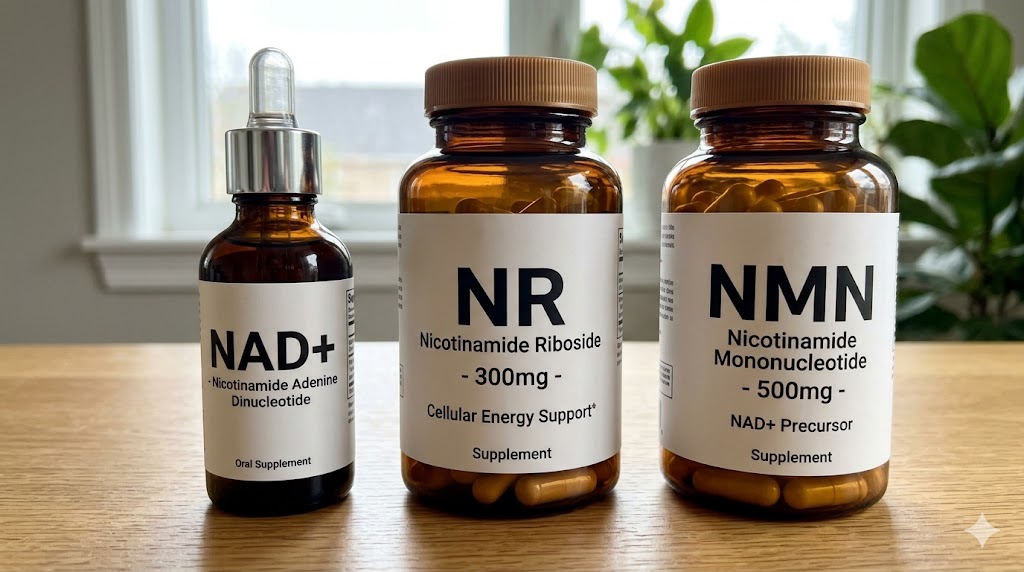
NAD+, NMN, and NR - three molecules with a shared goal. Here’s our breakdown of how they differ, what the evidence says, and which approach is right for you.
Book Now
If you’ve spent any time at all researching complex subjects like cellular health, longevity, or performance optimisation, you might have come across 3 acronyms that are typically used interchangeably, by mistake or otherwise, but are not the same thing at all. These particular clinical terms that you might’ve seen are NAD+, NMN, and NR.
To make matters worse and even more confusing, especially to the average person, the supplement industry has complicated this even further by marketing all 3 as variations of the same solution, with roughly equal clinical value and boasting similar properties. But know this: they are not the same.
Understanding the difference matters a lot more than it might seem at first glance, not merely because one is good while the others are fraudulent. Nope, it’s because the right approach, NAD+, NMN, or NR, depends on what you’re trying to achieve, and your current physiological state, as well as how quickly you need to see results.
The Relationship Between NAD+, NMN, And NR
If you’re still confused, don’t worry, because we’ve prepared this detailed guide to help you navigate the confusing waters that separate these 3 molecules, and give you the in-depth clinical framework to make that decision. With that in mind, there’s no better place to start than their respective biology, because the confusion begins right here. So, what are NAD+, NMN, and NR, respectively?
NAD+ (Nicotinamide Adenine Dinucleotide)
NAD+ (Nicotinamide Adenine Dinucleotide) is the active molecule, and it’s actually the coenzyme that your mitochondria use to produce ATP (Adenosine Triphosphate), which is what sirtuins require to regulate your body’s gene expression and DNA repair.
Additionally, PARP enzymes also consume it during the cellular stress response. As such, NAD+ is the endpoint, where every single cell in your body needs it and depends on it, uses it pretty much continuously, and they can’t function otherwise without it.
NMN (Nicotinamide Mononucleotide)
NMN (Nicotinamide Mononucleotide) is a direct precursor to the aforementioned NAD+ molecule. Scientifically, it sits just one enzymatic step away from NAD+ in the biosynthesis pathway inside your body.
Therefore, when NMN enters a cell, it’s converted to NAD+ by the enzyme NMNAT. In so doing, it doesn’t have a strong biological activity of its own, but its value lies entirely as a substrate for NAD+ production.
NR (Nicotinamide Riboside)
NR (Nicotinamide Riboside) is a precursor to NMN, which itself is a precursor of NAD+, as we’ve established earlier. By this point, I think you can see where the hierarchy goes, and NR sits just two enzymatic steps away from NAD+.
The process begins with NR, which is first converted to NMN by the enzyme NRK. From there, NMN is then converted to NAD+ by NMNAT. Once again, just like NMN earlier, you won’t find any independent biological activity here with NR, as its value is upstream of the value of NMN.
NAD+ vs NMN vs NR
The hierarchy amongst these 3, therefore, is linear: NR → NMN → NAD+.
This is the foundational fact that the supplements industry tends to gloss over, causing a lot of confusion among patients. To put it simply: oral NMN and NR supplements don’t deliver NAD+ directly.
Instead, they work by delivering precursors that your body must then convert to NAD+ through existing enzymatic pathways. Moreover, that conversion process introduces a bit more variability, rate-limiting steps, and absorption challenges that would affect how much NAD+ actually gets produced.
How Each Is Absorbed And Why It Matters
On that note, it’s worth discussing how each of these molecules is absorbed, and why it even matters that their absorption rates and processes are distinct. While it might not sound significant, the way in which NAD+, NMN, and NR are absorbed is where we’ll see the clinical differences between these 3 molecules become practically significant.
Oral NMN
For years now, the central debate in the medical field has been whether or not NMN could be absorbed intact, directly through your gut wall, or whether it had to first be converted to NR before crossing your intestinal epithelium.
Finally, back in 2019, there was much buzz and significant excitement that the answer to this burning question had been found, as a study had identified that a specific NMN transporter (Slc12a8) in the mouse gut had enabled direct NMN absorption.
Furthermore, subsequent human pharmacokinetic studies have also confirmed that oral NMN does raise blood NMN and NAD+ metabolite levels.
In addition, in a randomised trial that was published in Cell Metabolism in 2021 (Yoshino et al.), they demonstrated that 250 mg of oral NMN absorption daily for 10 weeks can noticeably raise one’s skeletal muscle NAD+ levels, along with a much improved insulin sensitivity in postmenopausal women with prediabetes.
As such, we can conclusively say, once and for all, that the clinically-proven evidence for oral NMN absorption is legitimate. Nevertheless, there remain questions about its absorption ceiling and speed: how high can NAD+ levels actually rise through your oral precursor route, and how long does it take to do this overall?
Oral NR
Compared to NMN, NR has a much longer human clinical trial record, and thus, we have a bit more context as to how it works and proof as to its effectiveness.
Multiple randomised trials have demonstrated that oral NR effectively raises blood NAD+ metabolite levels, which are dose-dependent, and several studies have also shown tissue-level effects, including in the muscle and peripheral blood cells.
In independent case studies, the NRCT001 trial (Martens et al., Nature Communications, 2018) showed that 1,000 mg daily of oral NR raised whole blood NAD+ levels by approximately 60% in healthy older adults after 6 weeks.
Other than that, another positive piece of factoid to report is that NR is generally quite well-tolerated. Otherwise, its limitation is the same as NMN from before, as it operates upstream of NAD+ production, depends heavily on the enzymatic conversion, and it can’t achieve the intracellular concentrations that direct NAD+ delivery can.
Intravenous NAD+
An IV (intravenous) delivery should bypass the entire absorption and conversion question entirely. In doing so, NAD+ molecules enter your bloodstream directly, and in response, your cells can take them up immediately.
You don’t have to deal with the conversion bottleneck that we explained earlier with NMN and NR, and as a bonus, there’s no gut absorption variability, and no rate-limiting enzymatic step between the intervention process and the outcome.
In all, the clinical results are of a speed and magnitude of NAD+ elevation that the prior oral precursors simply can’t match in any comparable timeframe. For reference, a single IV session of 500 mg to 750 mg of intravenous NAD+ can produce intracellular NAD+ levels that would otherwise have taken weeks of consistent high-dose oral NMN or NR to approach… Assuming it’s achievable by that route at all.
What The Evidence Actually Shows
With that said, however, neither NAD+, NMN, nor NR molecules are miracle cures for all of life’s many problems, and open, honest clinical communication requires some nuance that we have to consider. In this case, both the enthusiasts and sceptics are partially right with their respective arguments either for or against NAD+, NMN, or NR.
Well-Established Facts & Clinically-Proven Data
Here are some of the more well-established facts and clinically-proven points that we have to consider, both the good and the bad:
- NAD+ levels decline with age. Plus, this decline is mechanistically linked to reduced mitochondrial function, impaired DNA repair, and a compromised sirtuin activity.
- Oral NMN and NR both raise NAD+ metabolite levels in humans quite effectively in a lot of independent studies, so this finding isn’t disputed.
- NAD+ IV achieves much higher and faster intracellular NAD+ elevation than relying solely on oral precursors.
- Sirtuin activation, PARP function, and your body’s mitochondrial efficiency are NAD+-dependent.
Facts & Clinical Evidence That Are Still Emerging
While the above evidence has been well-proved by now, there are still a few findings that remain under testing, so here are some of the facts that you may want to take with a grain of salt, as the clinical evidence for them is still emerging:
- The precise dose-response relationship between NAD+ elevation and the specific clinical outcomes in humans remains unknown.
- We still don’t yet know whether the magnitude of NAD+ increase that is achievable by oral supplementation is sufficient to produce the cellular effects (in humans) that we have seen in animal models.
- Another huge elephant in the room is the long-term safety data for high-dose chronic NMN/NR supplementation. Otherwise, though, the short-term safety profile has been well-established.
- Additionally, we’re still unclear about the optimal delivery protocol for NAD+ IV across different clinical presentations.
To make things a bit easier to understand, our honest long-story-short summary is that the oral precursors are reliable, evidence-supported interventions for general NAD+ maintenance and modest elevation.
On the other hand, NAD+ IV is the appropriate route for therapeutic-level NAD+ elevation, where your goal might include a measurable clinical restoration rather than just background maintenance or a more passive effect.
Side-by-Side Comparison Of NAD+ vs NMN vs NR
For quicker and easier reference, we’ve made this handy little table for you to quickly refer to when comparing NAD+ IV, (oral) NMN, or (oral) NR, and figuring out which one is right for you:
NAD+ IV
NMN (Oral)
NR (Oral)
Steps from NAD+
0
1
2
Speed of effect
Hours
Weeks
Weeks
Magnitude of NAD+ elevation
High
Moderate
Moderate
Absorption variability
None
Low to moderate
Low to moderate
Requires physician supervision
Yes
No
No
Cost
AED 1,500 to AED 3,000 per session
AED 200 to AED 600 per month
AED 150 to AED 400 per month
Appropriate for acure restoration
Yes
No
No
Appropriate for long-term maintenance
Yes (if done monthly)
Yes
Yes
Clinical evidence in humans
Growing
Moderate
Established
Which One Is Right For Your Situation?
While there is strong merit to either NAD+, NMN, or NR, to make sure that you can enjoy the most effective outcome, you have to take a step back and analyse which one of these is right for you, based on your use case and your personal health goals.
The correct answer will depend on 3 very important variables: the severity of your NAD+ deficit, the speed at which you need restoration, and whether you are in a maintenance or a therapeutic phase.
So, let’s break it down one-by-one to see which one you should pick:
NAD+ IV Is The Right Starting Point If…
1. You are currently experiencing significant symptoms
This broad description would include various symptoms such as: persistent fatigue and tiredness that haven’t yet responded to positive lifestyle changes and optimisation, meaningful cognitive decline, prolonged post-viral symptoms, or recovery from burnout.
These all represent clinical presentations where the speed and magnitude of NAD+ IV delivery matter and make a noteworthy difference. If time isn’t on your side, IV therapy produces measurable change within just days, while typical oral precursors are a months-long intervention.
2. You are preparing for or recovering from a high-demand period
It might be a major competition that has worn you down, a HYROX event that has broken you into pieces, a period of intense professional load and tons of work or life-related stress, in addition to post-Ramadan recovery, or maybe even just too much transatlantic or transpacific long-haul travel.
Regardless, in each scenario, if there is a defined window where you need to be at your level best then and there or at a specific timeframe, and a defined deficit that must be addressed promptly, NAD+ IV delivery is the most appropriate tool for it.
3. You are over the age of 45
At this age, the enzymatic pathways that convert NMN and NR to NAD+, which, as we mentioned earlier, are NRK and NMNAT, both of which would often decline with age.
Older adults tend to feature a diminished capacity to convert oral precursors to NAD+ at the rates that are commonly demonstrated in younger study populations. That said, NAD+ IV delivery sidesteps this entirely, so it should be worth exploring all on its own.
4. You want to establish a baseline before transitioning to oral maintenance
This is no doubt the most clinically rational approach for most patients, which starts with a loading series of IV delivery sessions to establish elevated NAD+ levels, followed by oral NMN or NR as a maintenance strategy.
Compared to just starting with and taking oral supplements alone, this process is way more effective if you’re expecting noticeable results, and if you do it right, it can bring meaningful health benefits down the line, too.
Oral NMN Or NR Is The Preferred Approach If…
1. You are in maintenance mode
By this stage, you’ve completed the NAD+ IV loading series, your symptoms have been mostly or thoroughly resolved, and your goal now is sustaining elevated NAD+ levels between sessions.
In that case, daily oral NMN at 250 mg to 500 mg, or daily oral NR at 300 mg to 1,000 mg, should provide a meaningful ongoing contribution, absorption, and recovery.
2. You are asymptomatic and focused on prevention
Younger patients, especially those in their late-20s to mid-30s, may find oral NMN or NR supplementation more than sufficient as a starting point, especially if they didn’t notice any significant symptoms, and they retain an interest in longevity optimisation.
Nonetheless, if that’s not enough, then you might be able to consider IV therapy, which can be added in periodically as a performance booster or seasonal intervention.
3. Access or logistics that make IV therapy impractical as a primary approach
It’s a common enough sight to say that daily NMN or NR oral supplementation could be easily achievable practically anywhere in the world. The same can’t always be said about NAD+ IV, however.
Therefore, for patients who travel extensively and cannot maintain convenient clinic access consistently, oral NMN or NR provides a baseline that keeps their NAD+ levels from falling significantly between your periodic, scheduled IV therapy sessions.
NMN vs NR: Does It Matter Which Oral Precursor You Choose?
With plenty of cross-mentions between NMN and NR, how different are they from each other, and does it really matter which specific oral precursor you choose?
Well, it turns out that, practically, the differences between them are quite modest and fairly minor at most:
- NMN sits closer to NAD+ in your biosynthetic pathway, which does give it a theoretical advantage over NR.
- NR has a longer and better-characterised human clinical trial record and safety profile, which gives it a practical advantage over NMN.
The costs between NMN and NR are pretty much similar, too, and thus far, neither has been able to demonstrate a clear clinical superiority over the other in head-to-head human trials.
Nevertheless, with that being said, our clinical preference at Chairon House is NMN for maintenance following IV loading, primarily because of its proximity to NAD+ in your biosynthetic pathway, which may offer marginal advantages with patients who report compromised enzymatic conversion efficiency.
The latter case is normally more common with older patients and those with metabolic dysfunctions. Frankly, however, the honest answer here is that the difference between NMN and NR isn’t nearly as important as maintaining consistency: whichever specific precursor a patient continues to take daily and consistently is, ultimately, the right pick.
What To Look For In An Oral NMN Or NR Supplement?
If you’re still having trouble choosing between the many oral NMN and NR supplements offered today, here’s our checklist of what you should be on the lookout for:
- Ensure that they have been tested by a 3rd-party for purity, and in some cases, a Certificate of Analysis is available for verification.
- Check that they are made with a stabilised formulation, as NMN, in particular, degrades rapidly without the proper handling protocols.
- Make sure that you’re not dealing with any proprietary blends that attempt to obscure the actual NMN or NR dosage.
- Check for any liposomal or sublingual formulations for potentially improved absorption, but the clinical evidence that we have now remains preliminary.
Our Integrated Protocol: How We Use All 3 At Chairon House
Although each of them has its own merits, when combined in a carefully planned and personalised integrated protocol, the effects of NAD+, NMN, and NR together could be extremely powerful and deliver an effective healing outcome.
The particular framework that we use in clinical practice here at Chairon House, to be clear, isn’t some competition between different delivery routes. Rather, it’s a sequenced protocol design that uses each approach where it is most appropriate, utilising all 3.
Phase 1 - Loading (Weeks 1 to 3)
This starts with NAD+ IV therapy sessions, and there should be 4 to 6 of them in total, depending on your specific, individualised protocol. By doing this, we’re able to establish intracellular NAD+ at a level that oral (NMN or NR) supplementation alone can’t achieve in a comparable timeframe.
Additionally, this is also where clinical work happens, and you might notice that your overwhelming sense of fatigue is slowly resolving itself, your cognitive clarity begins to return, and your cellular energy system is being meaningfully restored rather than just marginally supported.
Phase 2 - Maintenance (Ongoing)
This phase commences with monthly or 6-weekly NAD+ IV sessions, which are also then combined with daily oral NMN at 250 mg to 500 mg. The purpose of the IV session is to prevent a significant trough between sessions.
Instead, the oral NMN supplementation would help to provide a continuous background contribution. Together, between them, they sustain your NAD+ at a level that’s closer to the post-loading baseline than either approach alone.
Phase 3 - Targeted Interventions
We start this final phase with singular IV therapy sessions that are timed to specific high-demand events or occurrences that you might be experiencing in your life at that time, thus providing a timely intervention when you need it most.
These scenarios might include recovering from jet lag, the post-Ramadan reset, trying to recover from burnout, pre-competition loading for athletes, and more. All of these considerations for each of our patients are layered onto the maintenance protocol as the unexpected circumstances in your life warrant.
Overall, this framework is built on the recognition and understanding that NAD+ is not a one-time problem with a one-time solution. In reality, it is a continuously consumed resource in a continuously demanding environment. At the end of the day, the most effective clinical approach manages these risks and factors accordingly.
The Bottom Line
On the whole, NAD+, NMN, and NR are not competing products. Rather, they are different tools that aim to achieve a similar, common biological goal, though they may operate at different points on the same pathway in your body, and are otherwise appropriate for different phases and purposes.
If you are currently managing a clinical deficit, such as fatigue, cognitive impairment, or recovery from a demanding period, then NAD+ IV is the ideal starting point. However, if you are maintaining elevated NAD+ levels following an IV loading, or if you are building a preventive longevity protocol as a younger adult, then oral NMN or NR supplementation is a valuable daily complement.
The worst possible outcome that you’d have to suffer is choosing oral supplementation (NMN or NR) when, instead, NAD+ IV therapy is clinically indicated, and you should have taken that instead. Thus, you’re left waiting months for a response that might not come, and prematurely concluding that NAD+ therapy doesn’t work. On the contrary, it usually does work, but only when the delivery route matches your body’s clinical needs.