March 30, 2026
Peptide Therapy for Brain Health in Dubai
Stop accepting brain fog as a side effect of a busy life. Learn how targeted peptide protocols like the NeuroSharp stack can fix the root causes of mental exhaustion.
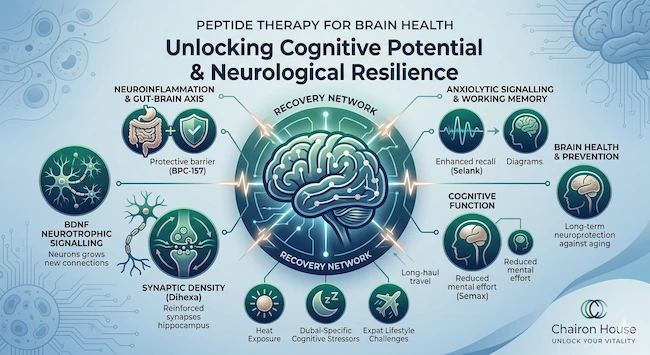
Stop running your brain at 60 percent.
It’s hard for most people to accept brain fog, poor recall, and mental fatigue as the unavoidable consequences of a busy lifestyle… But it’s true, and no, there’s no shame in admitting it! In fact, the sooner you admit these faults, the quicker you can treat them.
Here, at Chairon House, we see those symptoms differently, not as deficiencies or faults, but rather as natural, biological signals that deserve a clinical answer, not merely to be fixed momentarily with a third cup of coffee.
Peptide therapy might be the answer you’re looking for, so let’s closely examine what it does, how it works, the benefits it offers, who gains from it most, and what the entire process of treatment looks like from start to finish.
What is Peptide Therapy for Brain Health?
Peptide therapy involves the administration of short chains of amino acids, which are the biological messengers that your own body already naturally recognises, to support specific physiological processes.
In the context of cognitive function, certain peptides are used to target neuroplasticity (which is the brain's ability to form and reorganise connections), neuroinflammation, mitochondrial energy production, and the synthesis of crucial growth factors that maintain healthy brain tissue.
It should be noted that peptide therapy is not the same as nootropic supplements that you can purchase at the local pharmacy. In fact, clinically administered cognitive peptides operate at a mechanistic level, thus allowing them to interact with receptor systems in your brain and your nervous system, which oral supplements typically cannot reach at therapeutic concentrations.
For Dubai residents, in particular, this matters a great deal. The UAE population faces a confluence of natural cognitive stressors that are genuinely distinct, which include (but aren’t limited to):
- Chronic heat exposure from the weather, which elevates cortisol levels and oxidative stress
- Fragmented sleep patterns, either driven by Ramadan fasting schedules or late social culture
- High-pressure and fast-moving professional working environments
- An expat lifestyle that frequently involves long-haul travel and time zone disruption
These are not trivial stressors, either. Over time, the compounding effects are enormous and disruptive, and if left as-is, untreated, they can gradually accelerate one’s cognitive decline measurably faster than baseline ageing.
The Science: How Cognitive Peptides Work
To understand how cognitive peptides work and what this all means, it’s easier if we break them down one by one.
Neurotrophic Signalling
You might be surprised to learn this, but your brain isn’t static. If anything, it continuously remodels itself through an intricate process that’s governed largely by brain-derived neurotrophic factor (also known as “BDNF”).
BNDF is a protein that essentially acts like a fertiliser for neurons. It supports the growth of new synaptic connections (synaptogenesis), it protects existing neurons from apoptosis (programmed cell death), and is vital for learning and memory consolidation.
Chronic stress, poor sleep, and high sugar diets all suppress BNDF. Thankfully, however, many of the cognitive peptides used in clinical protocol work by restoring or amplifying this important pathway.
Semax, for example, is a synthetic analogue of a fragment of adrenocorticotropic hormone (ACTH4-7). So, instead of just simply stimulating cortisol as the full ACTH molecule effectively does, Semax selectively activates melanocortin receptors in your central nervous system, and as a result, triggers a significant upregulation of BDNF and its downstream signalling cascade. [Source: Dolotov OV et al., Journal of Neurochemistry, 2006]
In clinical observation, it was found that patients on Semax frequently report a qualitative shift in mental clarity within the 2nd or 3rd week post-treatment, and it’s not even a stimulant effect, either, but a sense of reduced effort when thinking.
The HGF/c-Met Pathway and Synaptic Density
Then, we have Dihexa (N-hexanoic-Tyr-Ile-(6) aminohexanoic amide), which acts on the hepatocyte growth factor (HGF) and its receptor c-Met, which is a pathway that plays a critical role in synaptogenesis.
To put it simply, researchers at Washington State University demonstrated that Dihexa was approximately 10-million times more potent than BNDF itself at promoting synapse formation in the hippocampal tissue. The hippocampus, of course, is the all-important region of your brain that’s most directly implicated in memory encoding. [Source: McCoy et al., Journal of Pharmacology and Experimental Therapeutics, 2013]
Nevertheless, we should be direct and upfront here by making it clear that this doesn’t mean that Dihexa produces 10-million times the subjective effect. In reality, it means the signalling threshold required to activate the pathway is dramatically lower, which does come with some implications for dosing precision and trying to avoid the side effects from over-stimulating.
Neuroinflammation and the Gut-Brain Axis
Next up, we then have BPC-157 (Body Protection Compound-157), which is a crucial pentadecapeptide that’s derived from a protective gastric protein.
While its primary literature base mostly covers gastrointestinal healing, we’ve now come across emerging neurological research which demonstrates how it boasts meaningful neuroprotective and anti-inflammatory effects. This also includes the modulation of dopaminergic and serotonergic neurotransmission. [Source: Vukojevic J et al., Brain and Behaviour, 2022]
Clinically, BPC-157 is relevant to cognitive health through two critical mechanisms:
- First, there’s its dampening of systemic neuroinflammation, which is a common driver of brain fog you have that standard blood panels often rarely measure.
- Second, there’s also its stabilisation of your gut-brain axis, and seeing that approximately 90% of serotonin is produced in the gut itself, gut lining integrity has a direct and underappreciated impact on mood and cognitive performance.
Anxiolytic Signalling and Working Memory
Last but not least, we have Selank, which is a synthetic analogue of the endogenous peptide tuftsin, and it acts primarily on the GABAergic system and the regulation of monoamine neurotransmitters.
A controlled clinical study found that Selank produced significant anxiolytic effects (basically, a reduction in anxiety), but without the sedation or dependency risks that are commonly associated with benzodiazepines, while simultaneously improving working memory scores. [Source: Zozulya AA et al., CNS Drug Reviews, 2006]
Therefore, for executives and high-performers who experience disappointing cognitive underperformance that’s been driven by baseline anxiety, which is a pattern that we observe frequently here at Chairon House, this distinction matters a lot more than most people think.
Reducing the neural noise of chronic low-grade anxiety can measurably improve your cognitive bandwidth.
Benefits Of Cognitive Peptide Therapy: What Patients Report and What Evidence Supports
With all of that being said, there are numerous benefits to cognitive peptide therapy, and here are just some of the more noteworthy upsides:
1) Improved Working Memory and Processing Speed
Working memory, which defines your ability to hold and manipulate information in real time, is among the first cognitive faculties to suffer from chronic stress and poor sleep.
Yet, patients on Semax-inclusive protocols typically report noticeable improvement in their working memories within just 3 to 4 weeks of treatment.
Additionally, recent clinical evidence also supports BNDF upregulation as a plausible mechanism. [Source: Dolotov OV et al., Journal of Neurochemistry, 2006]
2) Reduced Brain Fog
Sadly, brain fog is not commonly a diagnosable condition on a typical blood panel, and this is precisely why so many patients with it are often told that they’re “fine” and then simply sent home without proper treatment in mind.
Nevertheless, at Chairon House, we treat brain fog as a symptom cluster, and cognitive peptide protocols that effectively address neuroinflammation, BDNF insufficiency, and mitochondrial dysfunction concurrently fix many of its root contributors.
"I'd been functioning at about 60% for two years. After six weeks on the NeuroSharp protocol, I felt like the lights had been turned back on — work that used to take me four hours was done in two." — Female patient, 41, financial services professional, Dubai (name withheld).
3) Improved Stress Resilience Without Sedation
The anxiolytic profile of Selank, combined with the BDNF-stimulating effects of Semax, altogether creates a therapeutic condition that many patients would simply describe as a “quieter, calmer mind”.
This is to say, they experience reduced cognitive noise without drowsiness, and this is categorically different from pharmaceutical anxiolytics. More to that, most patients can notice this effect within just 2 to 3 weeks of beginning a Selank protocol.
4) Neuroprotection Over Time
It’s important to remember that the long-term case for cognitive peptides is preventive. Neurodegeneration does not announce itself so obviously, and it’s very easy to miss, as it accumulates over many decades of oxidative stress, neuroinflammation, and BDNF suppression.
Patients in their 40s and 50s who are cognitively intact but concerned about their health trajectory have increasingly become the profile that we commonly see at our clinic here at Chairon House. While the evidence base for cognitive peptides as neuroprotective agents is early-stage at the moment, it remains directionally consistent.
5) Enhanced Mood Stability
Moreover, thanks to BPC-157's influence on dopaminergic and serotonergic pathways, Selank's GABAergic modulation, patients on combined cognitive protocols frequently report a secondary benefit: emotional steadiness.
Not emotional blunting, per se, but steadiness. Several patients have described it to us as feeling “more like themselves on a good day”, which is certainly a welcome addition to the list of benefits that cognitive peptides bring.
Who Is Cognitive Peptide Therapy For?
Given its many advantages and positive upsides, you might be tempted by the idea of getting cognitive peptide therapy, and if so, you might be a strong candidate if you could identify with one or more of the following scenarios:
- The fatigued executive - Imagine if you are performing well by external measures, but you still feel like you’re only operating at 60% to 70% of your cognitive capacity. You may even have had blood work done, but you’ve just been told that everything is “normal”.
- The 40+ adult who’s noticing a shift - Your recall isn’t as sharp as it was 5 years ago, as you also begin to notice that word-finding is slower. You’re not technically in a cognitive decline, but you can’t help but shake off the feeling like that’s where you’re heading.
- The high-volume athlete - You train hard, exercise regularly, and compete seriously, but you’ve noticed that your mental edge has somewhat slipped from its peak. You may even notice that your sleep has been disrupted, and recovery only feels partial at best.
- The expat under accumulated pressure - Relocation stress, time zone disruption, and social network rebuilding, mixed with career intensity in a new market and a completely different part of the globe, adds cognitive load. Remember that chronic stress can alter your body’s neurochemistry.
- The person who’s suffering post-COVID-19 - Neurological sequelae of COVID-19 are well-documented. Problems like brain fog, memory impairment, and fatigue are usually reported in a substantial proportion of COVID-19 patients who’ve had to deal with them for a long time. As such, cognitive peptide protocols with neuroprotective and anti-inflammatory profiles are an active area of clinical interest for this use case.
Who Should NOT Get Cognitive Peptide Therapy?
While cognitive peptide therapy brings many short, medium, and long-term benefits to the table, this doesn’t make it the right treatment for just about everyone.
As such, it’s just as important to figure out and then realise if and when you might not be a suitable candidate for cognitive peptide therapy. As per usual, do not begin any sort of peptide protocol without first consulting a trained and licensed physician!
Some of the absolute contraindications or serious cases that require significant caution when it comes to any kind of peptide therapy include (but are not limited to):
- Pregnancy or breastfeeding - The safety profile of common cognitive peptides during pregnancy has not yet been established, and as a result, these protocols are considered contraindicated.
- Active malignancy (cancer) - Peptides that upregulate growth factors (including BDNF and HGF) have also been contraindicated in active oncological conditions, given that there’s a theoretical risk of stimulating tumour growth.
- Severe psychiatric conditions - This will include active cases of psychosis, untreated bipolar disorder, or schizophrenia. Any peptides that modulate dopaminergic and serotonergic systems require very careful clinical supervision in these scenarios.
- Patients on MAOIs or specific psychiatric medications - These interactions require a full medication review before commencing any cognitive peptide protocol.
- Known peptide hypersensitivity - While this can be quite rare, to be on the safe side, it must be screened regardless.
- Severe renal or hepatic impairment - The clearance of certain peptide protocols may be affected as a result, and generally, protocols either require adjustment or complete avoidance entirely.
- Paediatric patients - Cognitive peptide protocols are not indicated for individuals under the age of 18.
IMPORTANT: This list is not exhaustive. With that in mind, a comprehensive health history and consultation with a trained and licensed physician is required at Chairon House before any peptide protocol commences.
What To Expect: The Peptide Protocol Process
With these in mind, if you’re still curious about considering a cognitive peptide protocol, especially with us here at Chairon House, here’s a brief overview of what this process would look like, from start to finish.
Before Your First Session
First and foremost, your cognitive peptide protocol here at Chairon House begins with a lengthy and comprehensive 45-minute consultation with one of our DHA-licensed and trained physicians.
During this process, we would review your health history, current medications, sleep data (if available, and data collected from wearables is also welcome), along with any relevant blood work.
Bear in mind that cognitive peptide protocols are personalised, so there’s no fixed stack that is applied uniformly to every single patient. Rather, each one is bespoke to every patient, based on their needs.
We may recommend baseline biomarkers that include inflammatory markers (hsCRP, IL-6, etc.), hormonal panels, and NAD+ levels, as cognitive performance does not exist in isolation from metabolic and hormonal health alone.
Furthermore, given Dubai’s unforgiving climate, it’s particularly important to ensure that you’re adequately hydrated before attending your consultation appointment. Cognitive symptoms are meaningfully worsened by even the mildest of hydration, and session tolerability is always better when you’re in a well-hydrated state.
During Your Session
Depending on which protocol is recommended to you, peptide administration may be done through a subcutaneous injection (which is performed by our clinical team), nasal spray (for peptides such as Semax and Selank, which are formulated for intranasal delivery to maximise CNS penetration), or an IV infusion (for combined NAD+/peptide protocols).
At Chairon House, we normally initiate cognitive peptide protocols with conservative dosing at the start, just to be safe. For example, Semax at 100 to 300 mcg intranasally, or Selank at 250 mcg. From there, we can then safely titrate based on the individual response from each patient.
Sessions are also conducted in a calm clinical environment, and most patients find the experience unremarkable, but in a good way. There’s no discomfort, no sedation, and no restriction on what you can do immediately after.
After Your Session
The vast majority of our patients leave their session without any noticeable immediate effect, positive or negative. This is a result of the specific mechanism of action for these peptides, which is cumulative and receptor-level, and they’re not there to produce an acute stimulant response.
With that in mind, you have to plan your protocol over the course of weeks, not hours. We also recommend maintaining a simple cognitive journal to keep track of progress and your response over the course of the protocol, with notes on your sleep quality, mental clarity, and mood.
Additionally, given Dubai’s intense heat and tropical climate, we’d advise avoiding direct sun exposure and any intense physical exercise for 2 to 3 hours post-session, especially when IV infusions are involved. Other than that, hydration remains important throughout the post-session period.
Risks and Side Effects
Now, while cognitive peptide therapy has a generally favourable tolerability profile when administered under proper clinical supervision, this doesn’t make it immune to causing a range of unwanted side effects and presenting risks.
Being honest about some of the side effects that you may notice is not a reason to avoid treatment, but rather, it’s the basis for making an informed decision on your part. With that said, here are some of the side effects that you have to keep an eye out for:
Common Side Effects
These commonly reported side effects are often mild and typically transient:
- Intranasal administration (Semax/Selank) - You might notice mild nasal irritation or even a transient headache in the first 1 to 2 sessions, though this usually resolves itself as your nasal mucosa adapts.
- Subcutaneous injection - Here, you might experience redness or minor bruising at the injection site. This is to be expected, and it’s also self-resolving.
- Initial fatigue - A small number of patients report some mild tiredness in the 24 hours following their 1st session. Thankfully, this is generally a one-time occurrence.
- Vivid dreams - Some patients on Selank also report increased dream vividness during the initial weeks. While it’s not distressing for most patients, it’s still worth monitoring, nonetheless.
Less Common Side Effects
These less common side effects are serious enough to likely warrant a clinical review:
- Persistent headache beyond 48 hours (or more)
- Anxiety or mood instability. This is rare with Selank, given its anxiolytic profile, but individual variations still exist
- Significant appetite changes
How We Mitigate Risks & Side Effects
At Chairon House, we take extra precautions to mitigate some of the aforementioned risks and side effects, and these include:
- All of the peptide formulations used at our clinic are pharmaceutical-grade and sourced from licensed compounding pharmacies that operate under UAE regulatory standards.
- Our clinical team performs a full pre-protocol health screen for each patient.
- All infusions and injections are conducted by trained and DHA-licensed clinical staff.
- Patients are provided with a direct contact number to our clinic for any post-session concerns, to ask for advice, or even to report any serious side effects.
On that note, please contact our clinic immediately if you begin to experience: chest tightness, difficulty breathing, significant swelling, and/or any acute neurological symptoms following treatment.
Cost of Cognitive Peptide Therapy in the UAE
If you remain interested in getting cognitive peptide therapy, here’s a breakdown of how much a typical protocol is expected to cost:
- [Entry] Single-peptide nasal: AED 800 to 1,200 / session
- [Standard] Dual-peptide protocol: AED 1,400 to 2,000 / session
- [Advanced] NeuroSharp Stack: AED 2,500 to 3,500 / session
- Consultation (initial): Complimentary
There are also various factors that you need to account for that would influence the final price, which include the specific peptides in your protocol, the dosing tier, the frequency of administrations, and the length of your personalised programme.
Moreover, the prices vary based on individual protocols, but here at Chairon House, you will be provided a personalised quote following your initial consultation.
Peptide Therapy in the UAE: Regulations & Safety
Peptide therapies fall under the jurisdiction of both the Dubai Health Authority (DHA) and the Ministry of Health and Prevention (MOHAP). As such, clinics offering these treatments must hold the appropriate DHA facility license, and administering physicians must hold active DHA practitioner licenses for their speciality.
Nevertheless, it’s important to note that not all peptides are equally regulated. Some are approved for clinical use only, while others exist as a compounded-medication, and some of the other peptides are not approved for administration in UAE clinical settings in their entirety.
A compliant clinic in the UAE will never administer substances that fall outside the DHA and MOHAP-approved or compounded medication framework, and they’ll source their peptides responsibly from licensed, regulated compounding pharmacies, never from unverified international suppliers or even online vendors.
Thankfully, it’s easy enough to verify a clinic’s credentials… You can verify that a Dubai clinic holds a proper and up-to-date DHA facility license through the official DHA smart services portal at (dha.gov.ae). A legitimate clinic should display its DHA license number prominently, and its physicians will hold individual DHA practitioner numbers that can be independently verified, as well.
At Chairon House, we hold an active DHA clinical facility license, and all of our peptide protocols are prescribed by DHA-licensed and trained physicians. Furthermore, all of our compounded formulations are sourced from licensed pharmacies, and our clinical processes adhere to strict MOHAP guidelines. We’re always transparent about what we administer and why, and we will always inform you if a requested protocol falls outside what we can safely and compliantly offer.
Frequently Asked Questions (FAQs)
How long before I notice a difference from cognitive peptide therapy?
This varies quite a bit by the individual and their respective protocol. Most patients who rely on Semax-based protocols generally report initial shifts in mental clarity and energy within 2 to 4 weeks. The effects of using synaptogenic peptides, on the other hand, like Dihexa, which work through structural changes in synaptic density, tend to emerge a lot more gradually: typically around 6 to 10 weeks. Nonetheless, we will always advise our patients to track their experience systematically rather than relying on day-to-day mood shifts as a metric, given that cognitive improvements are often noticed in retrospect. In other words, tasks that were previously difficult became easy before you consciously register the change.
Is cognitive peptide therapy safe?
Yes, specifically when administered by a trained and licensed physician, while also using pharmaceutical-grade compounds in a regulatory-compliant facility, cognitive peptides have a well-tolerated and clinically proven safety profile. In addition, the risk profile is materially different from self-administered peptides that are sourced online, which is a practice that we strongly advise against. Our pre-protocol screening exists specifically to help identify any contraindications before any treatment can begin, to best guarantee your safety and well-being.
Can I combine cognitive peptides with my existing supplements or medications?
Possibly, but ideally, and to be extra cautious, this requires a full medication review first, before your protocol begins. Certain combinations of medication, but particularly with psychiatric medications, blood thinners, or immunomodulatory drugs, require extremely careful evaluation. We’d recommend that our patients bring a complete list of every medication they’re taking at the moment, including supplements and their dosages, to their consultation. We’d advise the same measure for you, too, so please don’t begin any peptide protocol without this crucial review being done first.
How much does cognitive peptide therapy cost in Dubai?
The average cognitive peptide therapy at Chairon House costs approximately AED 800 to AED 3,500+ per session, though this would also depend on the complexity of your personalised protocol, as well as the peptides that are involved. Your initial consultation is complimentary, and an individualised pricing proposal is provided to you before you have to make any final commitments, and there’s never any pressure to commit. We also do not offer one-size-fits-all packages when it comes to any peptide therapy, so your protocol is built around your specific health profile, as is the case with all of our other patients.
Do I need ongoing sessions, or is this a one-time treatment?
Most cognitive peptide protocols are designed as courses, which typically run about 8 to 12 weeks, instead of ongoing, indefinite treatments. The goal here is to restore your body’s neurological function and resilience to a level that your body can then maintain adequately. Some patients may choose periodic booster protocols, particularly during periods of high stress, but this is not a dependency model. Consequently, we will always advise you on what the evidence supports and based on what suits you the most.
How is this different from taking nootropic supplements from a health store?
The core difference between cognitive peptide therapy and nootropic supplements is bioavailability and mechanism specificity. Many nootropic supplements contain either precursors or compounds that need to be converted through multiple metabolic steps before they can reach your brain, and absorption through oral administration can also be highly variable. Meanwhile, clinical peptides used that are used in our protocols are administered intranasally or by injection, which will target your central nervous system receptors directly with documented mechanisms of action. To be clear, this isn’t meant to be a criticism of supplements broadly, but it is a mechanistic distinction that should be relevant to patients who have tried oral approaches before, but without sufficient benefit.
What is the NeuroSharp protocol at Chairon House?
The NeuroSharp stack is Chairon House’s advanced cognitive support protocol, which combines Semax and Selank for neurotrophic and anxiolytic signalling, and BPC-157 for neuroinflammation modulation and gut-brain axis support, as well as an optional adjunct NAD+ infusion to address mitochondrial energy production. This stack is designed for patients with multi-factorial cognitive underperformance, and normally, this will include executives, 40+ adults noticing a cognitive shift, or post-COVID patients with persistent neurological symptoms. The exact composition, however, is personalised during your initial consultation with one of our physicians.
Conclusion
Whether you choose to believe it’s real or otherwise, cognitive decline is not inevitable, and brain fog is not something you simply have to accept. Peptide therapy for cognitive function represents a clinically grounded, proven, mechanism-specific approach when it comes to supporting brain health. Perhaps best of all, peptide therapy addresses the root causes of cognitive decline instead of temporarily masking symptoms.
For Dubai residents navigating a genuinely demanding environment, which includes the heat, professional pressure, disrupted sleep, time zone fatigue, and countless other troubles that life throws at you, restoring your neurological resilience has measurable quality-of-life implications that you simply can’t ignore forever.
The evidence base for cognitive peptides is growing, while the safety profile under real, proper clinical supervision is highly favourable, and the results that we’ve observed for ourselves here at Chairon House are consistent with what the published science would predict.
So, if you’d like to discuss whether cognitive peptide therapy is right for you, our clinical team offers a complimentary initial consultation. In addition, you can also reach us using WhatsApp, or you can contact us by phone. There’s never any obligation or pressure to make commitments, but instead, it’s just a frank and open conversation with one of our trained and licensed physicians, who will give you direct, honest answers.
DISCLAIMER: This article is for informational purposes only, and it does not constitute medical advice. Additionally, individual results may vary. Please consult a DHA-licensed physician before beginning any treatment programme. Chairon House is a DHA-licensed clinical facility, though the information contained in this article is not a proper substitute for a personalised medical consultation.
Conclusion
Cognitive peptide therapy offers a precise and scientifically grounded way to turn your brain's growth factors back on. But like any real medical protocol, it requires proper screening and a clinic that actually prioritizes your safety over a quick sale.
Ready to reclaim your mental edge?
Do not wait for your memory to slip further. Take proactive control of your cognitive health at Chairon House. Schedule your free, zero-pressure chat with our medical team and discover what a truly sharp mind feels like again.