March 27, 2026
Peptide Therapy for Men in Dubai: Restore Energy & Testosterone
Feeling constantly drained despite doing everything right? Discover how medically supervised peptide therapy in Dubai naturally restores men’s testosterone, energy, and drive.

Stop accepting "normal" when you feel terrible.
Are you noticing that just a little something is a bit off with your body… The energy that once carried you through back-to-back meetings has become a slow, grinding fatigue? All that muscle you built meticulously in your 30s is slowly softening around the edges, even though you’re eating well, sleeping properly, and training regularly when you can.
Alas, these are just some of the many downstream effects of a hormonal environment that has been slowly eroding for years. Thankfully, however, there’s now a medically and scientifically sound solution at hand for us, as peptide therapy offers you a clinically supervised and biologically precise intervention that works with your body’s hormonal architecture, not against it.
As such, instead of overriding your endocrine system with synthetic hormones, targeted peptide protocols help to stimulate your pituitary glands, support your HPG axis, and restore the signalling cascades that govern your energy, body composition, libido, and cognitive function, though it’s not without some caveats, which we’ll explore further.
Here, at Chairon House, a DHA-licensed regenerative medicine clinic in Dubai, every single protocol begins with a comprehensive assessment, and you’re being monitored at every stage to ensure your safety and that we’re able to meet your health goals. With that in mind, let’s check out what peptide therapy is, how it works, whether it may be appropriate for you, and what sort of results are clinically realistic.
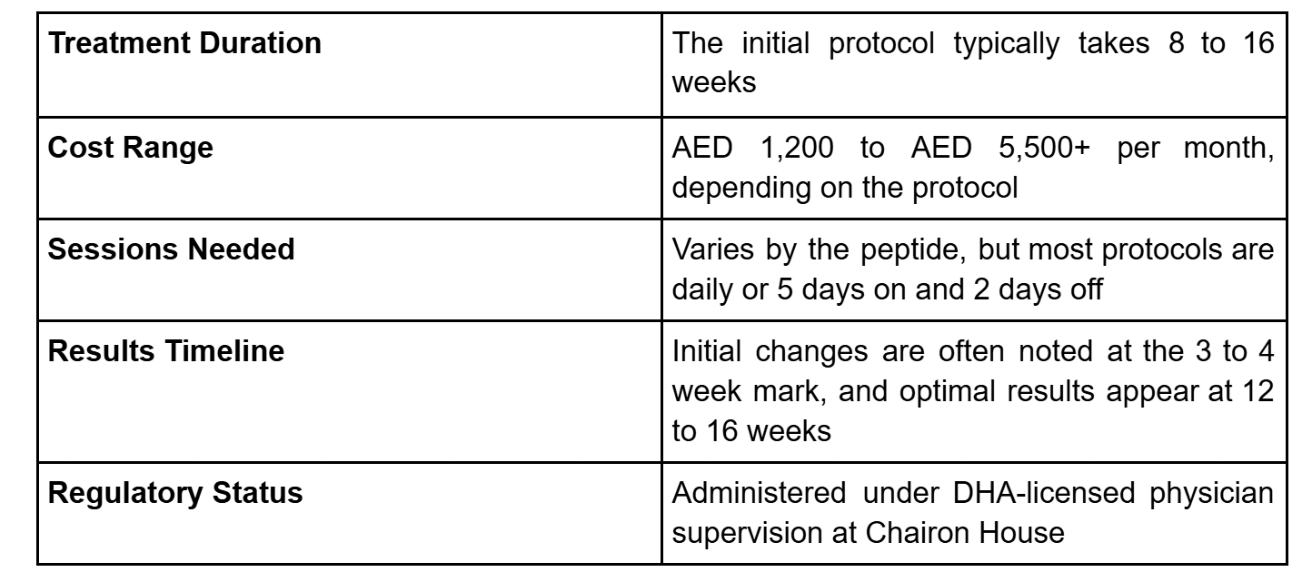
Quick Facts At A Glance
What Is Peptide Therapy & How Does It Affect Men’s Health?
So, what exactly is peptide therapy, then? To put it simply, peptide therapy involves the administration of specific short chains of amino acids, called peptides, that can act as biological signals within your body.
Therefore, you can think of peptides as highly precise messengers, which could bind to receptors on cells and instruct those cells to perform specific functions, from releasing growth hormones to regulating inflammation, fat metabolism, and even sexual function.
When we put this in the context of men’s health, peptide therapy is used to support or restore your hormonal balance, increase lean muscle mass, reduce visceral fat, improve libido, enhance sleep quality, and sharpen cognitive performance.
Best of all, this is done without the abundance of legal and health complexities that naturally come with and are often associated with anabolic steroids or “testosterone replacement therapy”, also known as “TRT”.
Why This Matters for Men Living in the UAE
The UAE’s very particular climate and lifestyle (especially among expats) present a really unique hormonal challenge.
Past research has linked chronic heat stress to elevated cortisol levels (your body’s primary stress hormone), which directly suppresses testosterone production. [Source: Charkoudian N. et al., Journal of Physiology, 2003]
When you consider the typical expat profile… Long working hours, frequent travel, a diet reliant on restaurant dining and take-outs, not to mention disrupted sleep… And it’ll soon become abundantly clear why low testosterone and suboptimal hormonal health are genuine concerns for so many men in the region.
In fact, according to a 2022 survey by the Dubai Health Authority (DHA), they found that nearly 38% of men over the age of 40 who sought help at primary care facilities reported a variety of symptoms that are consistent with androgen deficiency.
This would include the typical symptoms that we’ve mentioned thus far, which include fatigue, decreased libido, and mood disturbances. Peptide therapy helps provide a regulated, physician-supervised pathway to try to address these concerns proactively and safely.
‘A 41-year-old British expat executive came to our Dubai clinic with exactly this picture — fatigue, a softening physique, and a testosterone result his GP had dismissed as fine. He had spent six months assuming it was stress. Within eight weeks of a personalised peptide protocol, he described it as ‘feeling 32 again.’ — Clinical observation, Chairon House, Dubai.
How Hormonal Imbalances Affect Your Lifestyle
Otherwise, if you go to the local GP and you let them do a blood test, they might tell you that everything looks like it’s within a “normal range”, although your passion and drive, be it professional, personal, mental, or physical, all feel like they’re running on fumes. So, then, why do you feel like you’re now a diminished version of yourself, more than ever?
Well, here’s something that conventional medicine doesn’t really make super clear from the get-go: that aforementioned “normal range” isn’t the same as “optimal”. If anything, the average person’s testosterone reference ranges are built on population averages, which also include average testosterone data across sedentary, unwell, and ageing men.
As such, even when you get a result that sits at the bottom of that testosterone range, it might technically be unremarkable on paper, but it’s still clinically meaningful in your daily life, regardless. Meanwhile, the UAE’s fast-moving working culture and expat environment constantly work against you, making the challenge even more formidable.
Chronic heat elevates cortisol, which directly suppresses your testosterone. In addition, disrupted sleep blunts growth hormones, and a high-pressure expat lifestyle sustains the body in a near-permanent state of stress and anxiety. If these are left unaddressed, the trajectory doesn’t simply plateau.
Instead, it actually accelerates. You’ll soon begin to notice reduced levels of muscle mass, increasing visceral fat, declining cognition, and even worsening cardiovascular markers, which are the typical consequences of ageing.
The Science: How Peptide Therapy Works
At the cellular level, many of the peptides that are used in men’s health protocols work primarily by stimulating the hypothalamic-pituitary-gonadal (HPG) axis, which is the main hormonal command chain that regulates testosterone production.
Other types of peptides used, on the other hand, work directly on the growth hormone secretagogue receptors (GHSRs) in the pituitary gland to amplify the natural pulsatile release of growth hormone (GH).
Functionally, unlike synthetic testosterone, which actually suppresses your body’s own hormone production, secretagogue peptides enhance your body's intrinsic hormonal signalling without shutting down its natural feedback loops.
This is the key clinical distinction between synthetic testosterone and peptide therapy, and they’re the primary reason many practitioners prefer peptide protocols, particularly for younger men or those who wish to preserve fertility.
What Are The Peptides Used In Men’s Health Protocols?
For context, here’s a list of the most popular peptides used for men’s health protocols here in Dubai, including by us here at Chairon House:
- Sermorelin: A growth hormone-releasing hormone (GHRH) analogue that can stimulate your pituitary glands to produce and secrete growth hormone. Clinical evidence shows that it’s able to improve body composition, sleep architecture, and energy in hypogonadal men. [Source: Walker R.F., Rejuvenation Research, 2006]
- Ipamorelin / CJC-1295: Often prescribed together, this combination provides a sustained, synergistic release of growth hormone. Ipamorelin is a selective GH secretagogue with minimal effect on cortisol, making it well-tolerated for most patients. Meanwhile, CJC-1295 extends the half-life of GHRH, amplifying the GH pulse. [Source: Sigalos J.T. & Pastuszak A.W., Sexual Medicine Reviews, 2018]
- PT-141 (Bremelanotide): This peptide acts on your melanocortin receptors in the central nervous system to improve sexual desire and erectile function. Unlike PDE5 inhibitors (e.g., Viagra), PT-141 works upstream, at the brain level, thus making it quite effective, even when vascular function is intact.
- BPC-157 (Body Protection Compound): A gastric peptide with systemic healing properties. It’s frequently used alongside other health protocols to help reduce musculoskeletal inflammation, support gut integrity, and improve tendon healing, which are all fairly common concerns for active men.
- Kisspeptin-10: It stimulates gonadotropin-releasing hormone (GnRH), which in turn drives LH and FSH production, which are your body’s upstream triggers for testosterone synthesis. Plus, emerging evidence also supports its role in reversing functional hypogonadism. [Source: Dhillo W.S. et al., Journal of Clinical Endocrinology & Metabolism, 2005]
Key Benefits Of Peptide Therapy for Men
If you’re not yet convinced that peptide therapy even works, here’s a clinically-proven list of the many benefits that these health protocols can provide.
1) Restored Energy & Reduced Fatigue
This is by far the most common problem that peptide therapy protocols aim to solve, and from our experience, many patients report a significant improvement in baseline energy within just 3 to 4 weeks of beginning a GH-secretagogue protocol.
Moreover, clinical observations at our clinic suggest that this is usually the first benefit that patients mostly notice: a more sustained energy curve throughout the day, without the afternoon crash that had become normalised in many of our patients prior.
2) Improved Body Composition
Growth hormone is fundamentally lipolytic. In other words, it breaks down fat. As such, a peptide-induced GH elevation promotes the preferential reduction of visceral fat, which is the metabolically active fat around the organs.
All the while, it could also help with stimulating lean muscle tissue. From what we’re able to observe, most patients on a 12-week protocol report measurable changes in waist circumference and muscle density by week 8.
3) Optimised Testosterone Levels
Other than that, peptides that specifically act along your body’s HPG axis, particularly kisspeptin analogues and certain GHRH peptides, can further support endogenous testosterone production.
In so doing, for men in the low-normal range, this often translates to improved mood, motivation, and libido (more on that next), without the fertility risks that are associated with synthetic exogenous testosterone.
4) Enhanced Sexual Function
Speaking of, PT-141 has demonstrated efficacy in improving erectile function and libido in men with hypoactive sexual desire disorder.
In a randomised controlled trial, intranasal PT-141 was able to produce very significant improvements in sexual satisfaction versus a placebo. [Source: Diamond L.E. et al.]
5) Better Sleep Quality
Additionally, we should bear in mind that growth hormone is released predominantly during deep sleep. Paradoxically, poor sleep reduces GH secretion, thus creating a never-ending vicious cycle.
To solve this, peptide protocols that optimise GH pulsatility often lead to deeper, more restorative sleep within 2 to 4 weeks, which itself has cascading hormonal benefits, thus leading to even more health benefits down the line.
6) Faster Musculoskeletal Recovery
For men who exercise and train regularly, or if you’re recovering from any sports-related injuries, BPC-157 and TB-500 (Thymosin Beta-4) both offer excellent targeted support for tendon, ligament, and muscle repair.
Furthermore, plenty of clinical evidence and extensive preclinical data also support their role in accelerating tissue healing. [Source: Sikiric P. et al., Current Pharmaceutical Design, 2018]
Who Is Peptide Therapy For?
With all that being said, however, it’s important to note that peptide therapy isn’t a one-size-fits-all sort of intervention.
Here, at Chairon House, we conduct a thorough intake assessment, which also includes a blood panel, body composition analysis, and a detailed clinical history, before we can recommend any sort of health protocol.
Otherwise, you may be a good candidate for peptide therapy protocols if you can identify with one or more of the following cases:
- The fatigued executive - Consider this situation: you’re currently in your late 30s to 50s, hard at work, and you’re high-performing professionally, but day-to-day, you’re chronically tired, are constantly fatigued, and are struggling to maintain muscle. On top of that, you’re also noticing a gradual erosion of drive and focus, at work or at home.
- The active man with a plateau - You exercise and train regularly and consistently, but you’re still unable to shift visceral fat and recover quickly the way you once did when you were in your late 20s. Worse, standard nutrition adjustments haven’t moved the needle one tiny bit, either.
- The man with low-normal testosterone - Your blood panels are “within range”, though you’ve noticed that you have multiple symptoms of androgen deficiency. Conventional medicine offers no such intervention at this level, unfortunately, but thankfully, peptide therapy addresses the root of these problems rather than just managing the symptoms.
- The expat navigating climate and lifestyle stress - Relocation, time zone shifts, heat acclimatisation, in addition to social disruption and work stress, all of which could easily take quite a heavy hormonal toll. On the bright side, however, some peptide protocols can better accelerate your body’s physiological adaptation.
- Men seeking fertility-compatible hormonal support - Unlike TRT, which stands for “testosterone replacement therapy”, many peptide protocols can safely preserve your body’s spermatogenesis. In so doing, this makes them the appropriate choice for men who wish to maintain fertility, while also addressing underlying hormonal suboptimality.
Who Should NOT Have Peptide Therapy?
Of course, it’s vital to remember that despite its wealth of benefits, just like any other medical intervention, there are clear contraindications that you need to bear in mind with peptide therapy protocols.
Peptide therapy is not appropriate or safe for everyone, and at Chairon House, our DHA-licensed physicians will identify these factors during your initial consultation. You should not proceed with peptide therapy if you have any of the following conditions:
- Active or suspected malignancy (cancer) of any kind, given the fact that growth hormone-stimulating peptides may, in some cases, theoretically promote tumour cell proliferation.
- Pregnancy or if you’re currently breastfeeding.
- Untreated or poorly-controlled Type 2 diabetes, because GH (growth hormone) elevation can transiently increase insulin resistance.
- Active autoimmune conditions where immunomodulation may actually worsen your disease.
- Severe hepatic (liver) or renal (kidney) impairment of any kind.
- Current use of corticosteroids or immunosuppressants, as these might interact with peptide signalling.
- History of acromegaly or other pituitary disorders.
- Men under 25 years of age, with whom the HPG axis is still naturally active, and intervention is rarely ever indicated.
IMPORTANT: Remember to always disclose your full medication list and medical history while meeting with our trained and licensed physicians for consultation. In fact, even over-the-counter medications and supplements can interact with peptide protocols.
What To Expect: The Process at Chairon House
Well, then, if you’ve made it this far and you’re still intrigued by the idea of coming over to Chairon House for a peptide therapy protocol, here’s an overview of the full process, from start to finish, just so you have an idea of what needs doing:
Before Your Treatment
Your first appointment involves a comprehensive consultation with one of our trained and DHA-licensed physicians. Crucially, this initial step will include a full blood panel (testosterone, LH, FSH, IGF-1, thyroid, and metabolic markers), body composition assessment, and a structured clinical intake interview, as well. At this point, no peptide protocol is initiated without some baseline data.
Since Dubai’s climate can be pretty unforgiving, too, we’d also recommend that you arrive at our clinic well-hydrated and not fasted for more than 12 hours. This is very important, as extreme heat can affect the baseline cortisol readings. This is why we often ask patients to rest and relax for at least 15 or so minutes before any blood draw.
During Treatment
Once you’re cleared, you may begin receiving treatment. It should be noted that most peptide protocols involve subcutaneous self-injection, with a small insulin-style needle administered at home. This is typically done in the evening, to better align with your body’s natural GH pulsatility during sleep.
If you’re ever unsure, however, don’t worry, because our clinical team can provide you with full training in the safe and proper injection technique and sterile practices before you leave our clinic and proceed to administer the peptide protocols at home. Alternatively, some protocols, such as PT-141, may be administered intranasally.
For context, here at Chairon House, we normally start GH-secretagogue protocols at CJC-1295/Ipamorelin 100mcg/100mcg nightly and titrate based on IGF-1 response at the 4-week mark. Nevertheless, peptide protocols are always personalised for each patient, and the doses that we mentioned here are indicative, not prescriptive.
After Treatment
Thankfully, most patients experience minimal downside post-treatment. Besides that, a follow-up blood panel at weeks 4 and 12 is standard, paired with additional protocol adjustments made along the way, based on your biomarker response and whether you report any other odd symptoms or side effects.
In the meantime, we don’t recommend any high-intensity exercise or training in the first 2 days of any new protocol, as your body is still calibrating at that point. Moreover, you should also be mindful of the weather, especially here in the UAE.
Given Dubai’s heat and extreme tropical climate, we would also advise patients to avoid prolonged outdoor exposure in the first 24 hours following any injection-site procedure. Additionally, we would also recommend that patients ensure adequate electrolyte intake to support the mild increase in metabolic activity that some patients often report.
Risks & Side Effects: What You Need To Know
Clinical honesty and transparency about any potential side effects are non-negotiable in our practice, and as with any sort of treatment, peptide therapy protocols can throw up some side effects and present risks that you should be aware of beforehand.
Here’s our honest summary and findings of what patients may experience, and while the vast majority of these side effects are mild and transient, you deserve to get the full picture:
Common Side Effects
- Injection site reactions - Some mild redness, bruising, and/or localised swelling, which typically resolves within 24 hours.
- Water retention - Particularly in the first 1 to 2 weeks post-injection, especially if you’re taking CJC-1295 peptide, though this is often transient.
- Mild flushing - Or warmth in the face immediately post-injection, in particular with PT-141.
- Transient fatigue - Or “heavy limbs” in the first few days post-injection, which normally improves further as your body adapts.
- Vivid dreams - Or altered sleep patterns in the first few weeks, which is a sign that the peptide protocol is engaging with your sleep architecture.
- Mild nausea - You may experience this with some peptides if injected without food and eating prior, which is easily mitigated by timing injections after meals.
Less Common Side Effects
- Transient elevations in blood glucose - This is often monitored via quarterly HbA1c for long-term peptide therapy protocols.
- Mild headache - You might experience this in the first 72 hours.
- Increased hunger - Particularly with ghrelin-stimulating peptides, which is relevant for patients who are managing their weight.
How We Mitigate Risks
Given that there are a handful of risks and side effects to be cautious about when we’re dealing with peptide therapy protocols, at Chairon House, we take extra precautions to mitigate some of these risks before we prescribe anything to you.
For context, every single patient receives baseline bloodwork, ongoing biomarker monitoring, and direct access to their supervising physician via our clinical WhatsApp line. At Chairon House, no peptide protocol goes unsupervised.
Nonetheless, if you experience anything beyond the common side effects that we’ve mentioned above, particularly swelling, difficulty breathing, or chest discomfort, be sure to contact the clinic immediately or head to your nearest emergency centre.
Peptide Therapy Cost in the UAE
If you’re still interested in peptide therapy, you should, of course, figure out how much it would cost you. In the UAE, peptide therapy pricing varies significantly based on the specific peptides prescribed, the protocol duration, any required monitoring, and the clinic tier.
The following table provides indicative ranges (in other words, estimates) for the most common men’s peptide therapy protocols at DHA-licensed facilities:
- CJC-1295 / Ipamorelin (GH Support): AED 1,200 to AED 2,200
- Sermorelin (Anti-Ageing / GH): AED 1,000 to AED 1,800
- PT-141 (Sexual Function): AED 800 to AED 1,500
- BPC-157 (Recovery and Healing): AED 900 to AED 1,600
- BPC-157 (Recovery and Healing): AED 2,800 to AED 5,500+
It’s important to remember that the prices we listed above are indicative and subject to change. The costs would vary based on individual protocols, dosages, and required monitoring.
NOTE: At Chairon House, a personalised quote is provided following your initial consultation, and you’re never forced into committing to any treatment or protocol.
It’s also crucial to note that DHA-compliant peptide therapy in the UAE is considered a medical treatment, not a wellness product. Therefore, the costs that we mentioned here reflect the need for thorough (and expensive) physician consultation, laboratory monitoring, pharmaceutical-grade compounded peptides, as well as ongoing clinical supervision.
Peptide Therapy in the UAE: Regulations & Safety
On that subject, peptide therapy operates within a strictly regulated medical framework in the UAE.
The two main regulating agencies, the Dubai Health Authority (DHA) and the Ministry of Health and Prevention (MOHAP), require that any prescription treatment, which includes peptides, be administered under the direct supervision of a trained and licensed physician. Self-prescribing and/or sourcing peptides from unregulated online vendors is illegal and potentially dangerous.
To be extra sure, here’s what makes a clinic legally compliant (for peptide therapy or any other treatment besides):
- Valid DHA or MOHAP facility license displayed on-site and verifiable via the DHA’s online license portal (dha.gov.ae).
- All prescribing physicians are trained and hold an active, relevant DHA license.
- Peptides are sourced from licensed pharmaceutical-grade compounding pharmacies.
- Patient records, informed consent documentation, and prescribing rationale are all maintained in compliance with DHA standards and regulations.
- No treatment is initiated without first getting a clinical consultation and some baseline investigation.
Chairon House operates a DHA-licensed facility in Dubai, with all peptide protocols prescribed and supervised by trained and DHA-licensed physicians. In addition, our pharmaceutical-grade peptides are sourced exclusively from DHA-approved suppliers.
Elsewhere, we maintain full clinical documentation for every patient, and we adhere very strictly to MOHAP guidelines and regulations on off-label prescribing, informed consent, and the safety of all of our patients.
Before beginning any sort of treatment, we would encourage you to verify any clinic’s DHA license independently at (dha.gov.ae). This is your right as a patient, and any proper and reputable clinic will welcome this.
Frequently Asked Questions (FAQs)
Is peptide therapy legal in the UAE?
Yes. Peptide therapy is legal in the UAE, so long as it’s prescribed and administered by a DHA or a MOHAP-licensed and trained physician. It should be noted that the regulatory framework requires that peptides be obtained from licensed pharmaceutical sources and used within a formal clinical protocol or treatment. On the other hand, sourcing peptides independently from online vendors is illegal and carries significant health risks.
How long before I notice results?
Most patients notice initial changes, including improved energy, better sleep, and early positive body composition shifts, within about 3 to 4 weeks. However, more meaningful changes in your testosterone markers, body fat, and muscle tone typically emerge between weeks 8 and 12. If you’re eager to seek the optimal results from a full protocol, they’re generally seen at the 16-week mark, with effects sustained with the appropriate maintenance.
Is peptide therapy the same as testosterone replacement therapy (TRT)?
No, they are distinct interventions entirely. TRT would involve administering exogenous (external) testosterone, which suppresses your body’s own hormone production, and it may even impair fertility. On the other hand, peptide therapy, particularly protocols that target the HPG axis, works by enhancing your body’s own intrinsic hormone production pathways. Many men choose peptides precisely because they wish to preserve natural testosterone production, while also retaining unimpaired fertility.
How much does peptide therapy cost in Dubai?
Indicative costs and estimates range from approximately AED 1,200 to AED 5,500+ per month, though this depends on the specific peptides prescribed, as well as the duration and the complexity of your specific, bespoke protocol. This would include the cost of a physician consultation, laboratory monitoring, and pharmaceutical-grade peptides. We, at Chairon House, would provide you with a personalised cost breakdown following your initial consultation with our trained and licensed physicians.
Can I combine peptide therapy with gym training?
Absolutely! In many cases, regular resistance training significantly enhances the effects and outcomes of peptide therapy protocols. Growth hormone secretagogues, for example, are especially effective if you engage in regular exercise, as the training itself is a natural GH stimulus. Regardless, our clinical team will advise you on optimal training protocols to complement your peptide programme accordingly.
Are there any blood tests required before starting?
Yes. Some baseline blood work is mandatory before any peptide protocol can start here at Chairon House. This typically includes testosterone (total and free), LH, FSH, IGF-1, thyroid panel, full metabolic panel, and HbA1c. The results of these blood tests would guide our clinical team in better personalising your peptide protocol, and thus provide the reference points against which your progress is measured post-treatment.
What is the difference between Sermorelin and CJC-1295/Ipamorelin?
Sermorelin is a synthetic analogue of natural GHRH (growth hormone-releasing hormone) and has a short half-life, thus making it suitable for daily dosing with a more physiological GH release pattern. On the flipside, CJC-1295 is a modified GHRH analogue with a significantly extended half-life, and it’s often combined with Ipamorelin, which is a selective GH secretagogue. Combined, they produce a stronger and more sustained GH pulse. Nevertheless, the choice between them depends on your specific goals, age, and baseline IGF-1 levels, and during the initial consultation, your physician should guide you in making the right choice.
Can peptide therapy help with weight loss?
In a way, yes. Peptide therapy can contribute meaningfully to fat loss, particularly when it comes to visceral fat reduction, as part of a comprehensive protocol. GH-stimulating peptides are also lipolytic (fat-mobilising), and clinical evidence does support their role in improving body composition. That said, however, peptide therapy isn’t a substitute for good nutrition and optimising your daily training and exercise. At Chairon House, we can integrate peptide protocols within a broader lifestyle and nutritional framework for the best results.
Final Thoughts
On the whole, peptide therapy represents a scientifically grounded, clinically supervised approach to the hormonal challenges that many men face today. This is particularly so in the high-demand environment and challenging climate of the UAE.
As such, whether you’re dealing with fatigue, reduced testosterone, poor recovery, or declining sexual function, targeted peptide protocols offer a pathway that works with your body’s own biology instead of bypassing or overriding it.
The key, of course, is proper assessment, pharmaceutical-grade peptides, and ongoing monitoring under physician supervision. In an industry with huge variations in the quality of clinics, having a DHA license and clinical rigour matters immensely.
At Chairon House, we believe that hormonal health is foundational, not optional, and our holistic approach combines proven regenerative medicine, clinical nutrition, and performance optimisation to help you function at your best, at every age.
If you’d like to discuss whether peptide therapy is right for you, then feel free to contact us, as our medical team offers a free initial consultation. You can contact us by phone, via WhatsApp, or by booking online at our website (chaironhouse.com).
DISCLAIMER: This article is for informational purposes only, and it does not constitute medical advice. Please consult a DHA-licensed and trained physician before beginning any sort of treatment.
Conclusion
It is time to stop masking the problem with more caffeine and sheer willpower. Peptide therapy offers a precise, scientifically grounded way to turn your natural hormonal signals back on. But like any real medical treatment, it requires proper baseline bloodwork, pharmaceutical-grade compounds, and a clinic that actually prioritizes your safety over a quick sale.
Ready to stop feeling like a diminished version of yourself?
You do not have to just accept the slow decline of aging or the brutal stress of Dubai life. Schedule a free chat at Chairon House today. Let us map out a safe, doctor-approved protocol so you can finally get your drive, your body, and your energy back.