March 30, 2026
Energy Biomarkers: The Map Behind Your Fatigue
Standard blood tests only look for disease. We look for performance. Learn how ferritin, Free T3, and insulin resistance are the real keys to your daily energy.
Stop settling for normal.
Fatigue is the most common reason people visit a doctor. It is also the one that gets ignored the most.
Usually, a doctor tells you that your bloodwork looks normal. They suggest you sleep more or stress less. But that normal range is built to find disease, not to help you perform at your best.
There is a huge gap between not being sick and being truly healthy. Most people live in that gap. Standard medicine simply stops looking there.
Persistent low energy is not just part of a busy life. It is a signal from your body. Your system is telling you that something is wrong.
This could be many things. Your mitochondria might be struggling. Your oxygen delivery might be slow. Your stress hormones might be out of balance.
You deserve to know why you cannot get out of bed feeling rested. This article explains the biomarkers that actually control your energy. We will look at how they work together to keep you moving.
How Your Body Makes Energy
Every cell in your body runs on a fuel called ATP. This is your universal energy currency.
Your mitochondria are the power plants that make this fuel. They burn sugar and fat using oxygen and vitamins. They also need the right hormonal signals to stay on track.
If any part of this chain breaks, you feel tired. This is why fatigue is rarely a single problem.
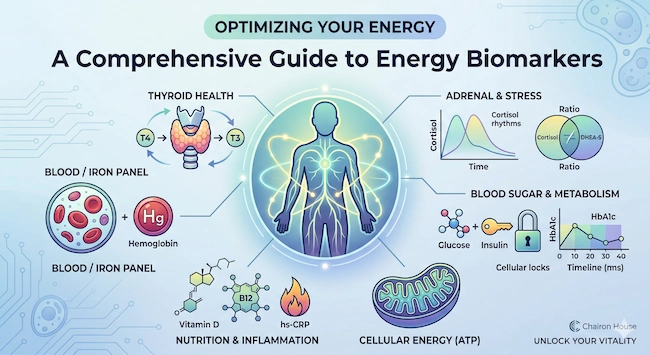
Think of it as a network of systems. Biomarkers give us a clear view of that network. We look at your cells, your thyroid, your stress levels, and your blood.
The goal is to see the whole story by reading these markers together.
Moving Oxygen Through Your Blood
1. Ferritin
Ferritin is how your body stores iron. It is the most important marker for fatigue in healthy people. It is also the most misunderstood.
Standard tests say you are fine if your level is above 15. But your body feels symptoms long before you hit that floor.
You might feel tired or cold. You might struggle to focus or exercise. These symptoms often appear when your ferritin is still technically normal.
We target much higher levels for our patients. We want you to feel energetic, not just avoid a deficiency.
One warning. Ferritin also goes up when you are sick or inflamed. A high number is not always a sign of good iron. We must check it alongside other inflammation markers to know the truth.
2. Serum Iron, TIBC, and Saturation
These three markers show how iron moves through your system.
Serum iron is what is currently in your blood. TIBC shows your body's capacity to carry that iron. Saturation tells us if that iron is actually available for your cells to use.
If your saturation is below 20 percent, you will feel tired. This happens even if your other iron levels look okay. We need all these numbers to see if your body is struggling to move fuel.
3. Red Blood Cell Health
Haemoglobin carries oxygen in your blood. If it is low, your cells cannot efficiently produce fuel.
Standard medicine uses a very wide range for these tests. But active people feel the drop much sooner.
We also look at the size and shape of your red cells. Small cells often point to low iron. Large cells usually mean you need more B12 or folate. The shape tells us exactly how to help you.
Your Thyroid Health
Your thyroid is the thermostat for your energy. It tells every cell in your body how fast to run. If your thyroid is slow, your energy will be slow too.
1. TSH
TSH is the signal from your brain to your thyroid. If your thyroid output drops, TSH goes up to push it harder.
The problem is that TSH only shows the signal. It does not show how your body actually uses the hormone. You can have a normal TSH and still feel exhausted.
Many people experience hypothyroid symptoms when their TSH is in the upper part of the normal range. We prefer to see your levels in a much tighter, more optimal window.
2. Free T4
This is the main hormone your thyroid makes. But it is mostly inactive. It must be converted into T3 before your cells can use it for energy. T4 shows us what your thyroid is producing, but it does not tell the whole story.
3. Free T3
This is the active hormone. It is the one that actually gives you energy. This is the marker that matters most for how you feel.
Many things can block your body from making enough T3. Stress, inflammation, and low nutrients are common culprits.
Most annual tests ignore Free T3. That is a massive mistake. You need to see TSH, T4, and T3 together to understand your metabolism.
Your Stress Hormones
1. Cortisol
Cortisol is your primary stress hormone. It helps you wake up and stay alert. In a healthy body, it is highest in the morning and lowest at night.
The timing of your cortisol matters as much as the amount. One morning test cannot tell us if your rhythm is broken.
High cortisol can make you feel wired but tired. You feel alert, but you are not actually refreshed. This pattern can ruin your sleep and drain your thyroid.
Low cortisol often follows long periods of stress. This leads to deep burnout. You might feel like you cannot keep up with basic tasks.
2. DHEA-S
This is a precursor to your sex hormones. It naturally declines as you age.
DHEA-S is important because it balances out cortisol. It helps your body repair and recover.
3. Cortisol to DHEA-S Ratio
This ratio shows if your body is in a state of repair or a state of breakdown.
A high ratio means you are under constant stress. This ages your body faster and kills your energy. Optimizing this balance is vital for your long-term health.
Managing Your Blood Sugar
1. Fasting Glucose and Insulin
Sugar is your primary fuel. Insulin is the key that lets that sugar into your cells.
If your cells stop listening to insulin, your energy drops. You might feel tired after meals or crash in the afternoon.
Most doctors only check glucose. But your glucose can look normal while your insulin is skyrocketing. High insulin is a warning sign that your body is working too hard to manage sugar. It is an early signal of energy problems.
2. HbA1c
This shows your average blood sugar over three months. It gives us the big picture.
Even if you are in the normal range, a higher number can mean your energy is becoming unstable. We want to see this number at a level that supports peak performance, not just the bare minimum.
How Inflammation Drains You
Chronic inflammation is a silent energy killer. It sends signals that directly slow down your mitochondria.
It also blocks your thyroid from working correctly. This is why you feel tired when you are sick. But low-grade inflammation can linger for years.
A high hs-CRP level means your body is fighting a quiet fire. This fire drains your battery every single day. We look for levels below 1.0 to ensure your system is clear and efficient.
Vital Nutrients for Energy
1. B12 and Folate
These vitamins are essential for making red blood cells. They also keep your nerves healthy.
A deficiency can cause brain fog and deep fatigue. You might feel these symptoms long before a standard test shows a problem. This is especially important if you do not eat meat or if you take certain medications.
2. Vitamin D
Vitamin D acts more like a hormone than a vitamin. Every cell needs it.
Low levels are linked to poor mood and low energy. Even in sunny places like Dubai, many people are deficient because they stay indoors.
We look for levels that support vitality and performance. The standard floor is simply too low for most active people.
Looking at the Whole Picture
Fatigue is rarely caused by just one thing. We often see these patterns:
- Low iron without anemia: You have no stores left, but your blood count is still within normal limits.
- Thyroid conversion issues: Your brain signal is fine, but your body cannot use the hormone.
- Stress hormone imbalances: You are stuck in a state of constant breakdown.
- Early insulin resistance: Your body is struggling to manage fuel.
- Inflammatory drain: A hidden fire is slowing down your power plants.
Reading one marker alone misses these connections. You have to look at the whole system to find the answer.
How We Check Your Energy
At Chairon House, we do not use a simple checklist. We use biomarkers to start a conversation about your life.
We look at your training, your sleep, and your diet. We want to know how you actually feel.
We never check ferritin alone. We look at the full iron panel. We do not just screen your thyroid. We check every hormone involved in the process.
We look for insulin resistance before it becomes a problem. We use inflammation markers to understand your environment.
This data helps us build your perfect recovery plan. We might use peptide therapy or NAD IV protocols to help your cells. But we always fix the underlying deficiencies first.
You cannot fix your energy if your system is missing the basic tools it needs to function.
The Final Word
Fatigue is not a character flaw. It is a biological problem that has not been solved yet.
The markers that actually explain your energy are usually missing from standard tests. These tests were built to find disease, not to help you thrive.
The difference in how you feel is found in the data. We find the signals long before they become a crisis.
Your energy is your most valuable asset. It is time to map it out and take it back.
Conclusion
Imagine waking up and finally feeling like yourself again. Npw, that's the true power of knowing your biomarkers. It is time to stop guessing. It is time to start living.
Ready to get your spark back?
Your energy is your most valuable asset. Do not let another day slip away in a fog of fatigue. Schedule your comprehensive energy panel at Chairon House and start your recovery today.